

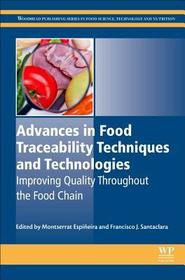
Advances in Food Traceability Techniques and Technologies
Improving Quality Throughout the Food Chain
Series: Woodhead Publishing Series in Food Science, Technology and Nutrition;
- Publisher's listprice EUR 215.00
-
83 979 Ft (79 980 Ft + 5% VAT)
The price is estimated because at the time of ordering we do not know what conversion rates will apply to HUF / product currency when the book arrives. In case HUF is weaker, the price increases slightly, in case HUF is stronger, the price goes lower slightly.
- Discount 20% (cc. 16 796 Ft off)
- Discounted price 67 183 Ft (63 984 Ft + 5% VAT)
- Discount is valid until: 30 June 2026
Subcribe now and take benefit of a favourable price.
Subscribe
83 979 Ft

Availability
printed on demand
Why don't you give exact delivery time?
Delivery time is estimated on our previous experiences. We give estimations only, because we order from outside Hungary, and the delivery time mainly depends on how quickly the publisher supplies the book. Faster or slower deliveries both happen, but we do our best to supply as quickly as possible.
Product details:
- Publisher Elsevier Science
- Date of Publication 22 June 2016
- ISBN 9780081003107
- Binding Hardback
- No. of pages402 pages
- Size 228x152 mm
- Weight 1220 g
- Language English 0
Categories
Long description:
Advances in Food Traceability Techniques and Technologies: Improving Quality Throughout the Food Chain covers in detail a topic of great importance to both the food industry which is obliged to provide clear and accurate labeling of their products and the government and other organizations which are tasked with verification of claims of food quality and safety.
The traceability of food products is becoming ever more important as globalization continues to increase the complexity of food chains. Coverage in the book includes the wide range of technologies and techniques which have been utilized in the tracing of food products. In addition, the ways in which the misuse of food traceability will affect the quality of food is also covered throughout.
The first part of the book introduces the concept of traceability in the food industry, highlighting advantages of a robust traceability and the difficulties involved in implementing them. The second part looks at the technologies used to trace products, and the third section reviews the legal requirements for food traceability in the EU, the US, and the rest of the world.
The final section contains a number of case studies which evaluate how food traceability has been successfully implemented in various foods focusing on the quality of the food.
MoreTable of Contents:
1. What Is Food Traceability?
2. Defining and Analyzing Traceability Systems in Food Supply Chains
3. Problems and Implementation Hurdles in Food Traceability
4. Alphanumerical and Optical Coding Systems for Food Traceability
5. Radio-Frequency Identification Usage in Food Traceability
6. The Use of Molecular Biology Techniques in Food Traceability
7. Near Infrared Spectroscopy and Food Authenticity
8. The Use of ICP-MS in Food Traceability
9. Future Technology in Tracing Animals on the Food Chain
10. Traceability Software for the Food Industry
11. Real-Time Tracking and Remote Monitoring in Food Traceability
12. Legal Requirements for Food Traceability in the European Union
13. Legal Requirements and Regulation for Food Traceability in the United States
14. Effective Use of Food Traceability in Product Recall
15. Analytical Approaches for the Evaluation of Food Protected Designation of Origin
16. Effective Use of Food Traceability in Cereal Grain Food Supply Chains
17. Effective Use of Food Traceability in Meat Supply Chains
18. A Closed-Loop Traceability System to Improve Logistics Decisions in Food Supply Chains: A Case Study on Dairy Products
19. Effective Use of Food Traceability in Animal Feed

