

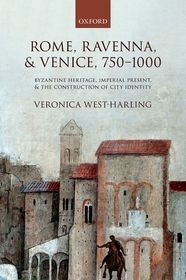
Rome, Ravenna, and Venice, 750-1000
Byzantine Heritage, Imperial Present, and the Construction of City Identity
-
10% KEDVEZMÉNY?
- A kedvezmény csak az 'Értesítés a kedvenc témákról' hírlevelünk címzettjeinek rendeléseire érvényes.
- Kiadói listaár GBP 147.50
-
66 596 Ft (63 425 Ft + 5% áfa)
Az ár azért becsült, mert a rendelés pillanatában nem lehet pontosan tudni, hogy a beérkezéskor milyen lesz a forint árfolyama az adott termék eredeti devizájához képest. Ha a forint romlana, kissé többet, ha javulna, kissé kevesebbet kell majd fizetnie.
- Kedvezmény(ek) 10% (cc. 6 660 Ft off)
- Kedvezményes ár 59 937 Ft (57 083 Ft + 5% áfa)
Iratkozzon fel most és részesüljön kedvezőbb árainkból!
Feliratkozom
66 596 Ft

Beszerezhetőség
Megrendelésre a kiadó utánnyomja a könyvet. Rendelhető, de a szokásosnál kicsit lassabban érkezik meg.
Why don't you give exact delivery time?
A beszerzés időigényét az eddigi tapasztalatokra alapozva adjuk meg. Azért becsült, mert a terméket külföldről hozzuk be, így a kiadó kiszolgálásának pillanatnyi gyorsaságától is függ. A megadottnál gyorsabb és lassabb szállítás is elképzelhető, de mindent megteszünk, hogy Ön a lehető leghamarabb jusson hozzá a termékhez.
A termék adatai:
- Kiadó OUP Oxford
- Megjelenés dátuma 2020. augusztus 20.
- ISBN 9780198754206
- Kötéstípus Keménykötés
- Terjedelem714 oldal
- Méret 236x163x45 mm
- Súly 1252 g
- Nyelv angol
- Illusztrációk XX black and white figures/illustrations 30
Kategóriák
Rövid leírás:
A comparative and interdisciplinary study, Rome, Ravenna, and Venice explores how three cities preserved and remoulded their common Byzantine past. It sheds light on how far these societies were the heirs of the Empire and how they imagined a new part-Roman, part-Italian identity in the centuries after their imperial links were severed.
TöbbHosszú leírás:
The richest and most politically complex regions in Italy in the earliest middle ages were the Byzantine sections of the peninsula, thanks to their links with the most coherent early medieval state, the Byzantine empire. This comparative study of the histories of Rome, Ravenna, and Venice examines their common Byzantine past, since all three escaped incorporation into the Lombard kingdom in the late 7th and early 8th centuries. By 750, however, Rome and Ravenna's political links with the Byzantine Empire had been irrevocably severed. Thus, did these cities remain socially and culturally heirs of Byzantium? How did their political structures, social organisation, material culture, and identities change? Did they become part of the Western political and ideological framework of Italy?
This study identifies and analyses the ways in which each of these cities preserved the structures of the Late Antique social and cultural world; or in which they adapted each and every element available to them to their own needs, at various times and in various ways, to create a new identity based partly on their Roman heritage and partly on their growing integration with the rest of medieval Italy. It tells a story which encompasses the main contemporary narratives, documentary evidence, recent archaeological discoveries, and discussions on art history; it follows the markers of status and identity through titles, names, ethnic groups, liturgy and ritual, foundation myths, representations, symbols, and topographies of power to shed light on a relatively little known area of early medieval Italian history.
The book is expansive in its methodological approaches, using texts, documents, and the evidence of material culture to make its cases...Rome, Ravenna, and Venice, 750-1000 offers a lot to its readers. As a whole, it is a satisfying and in-depth exploration of an often-unheralded period of Italian history, and beyond the narratives the book presents, it will be equally valuable for consultation on single issues (the populus of Rome, the evolution of Ravenna's episcopal authority, or Venice's urban fabric, for example).
Tartalomjegyzék:
Preface
Abbreviations
Introduction
A tale of three cities: history and histories
The actors: the elites and the populus I. ROME
The actors: the elites and the populus II. RAVENNA and VENICE
The stage: places of power, instruments of control
Exercising power in the city: the public space
Memory and the construction of city identity
Concluding thoughts

