

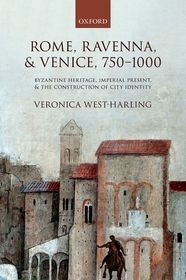
Rome, Ravenna, and Venice, 750-1000
Byzantine Heritage, Imperial Present, and the Construction of City Identity
- Publisher's listprice GBP 147.50
-
70 468 Ft (67 112 Ft + 5% VAT)
The price is estimated because at the time of ordering we do not know what conversion rates will apply to HUF / product currency when the book arrives. In case HUF is weaker, the price increases slightly, in case HUF is stronger, the price goes lower slightly.
- Discount 10% (cc. 7 047 Ft off)
- Discounted price 63 421 Ft (60 401 Ft + 5% VAT)
Subcribe now and take benefit of a favourable price.
Subscribe
70 468 Ft

Availability
printed on demand
Why don't you give exact delivery time?
Delivery time is estimated on our previous experiences. We give estimations only, because we order from outside Hungary, and the delivery time mainly depends on how quickly the publisher supplies the book. Faster or slower deliveries both happen, but we do our best to supply as quickly as possible.
Product details:
- Publisher OUP Oxford
- Date of Publication 20 August 2020
- ISBN 9780198754206
- Binding Hardback
- No. of pages714 pages
- Size 236x163x45 mm
- Weight 1252 g
- Language English
- Illustrations XX black and white figures/illustrations 39
Categories
Short description:
A comparative and interdisciplinary study, Rome, Ravenna, and Venice explores how three cities preserved and remoulded their common Byzantine past. It sheds light on how far these societies were the heirs of the Empire and how they imagined a new part-Roman, part-Italian identity in the centuries after their imperial links were severed.
MoreLong description:
The richest and most politically complex regions in Italy in the earliest middle ages were the Byzantine sections of the peninsula, thanks to their links with the most coherent early medieval state, the Byzantine empire. This comparative study of the histories of Rome, Ravenna, and Venice examines their common Byzantine past, since all three escaped incorporation into the Lombard kingdom in the late 7th and early 8th centuries. By 750, however, Rome and Ravenna's political links with the Byzantine Empire had been irrevocably severed. Thus, did these cities remain socially and culturally heirs of Byzantium? How did their political structures, social organisation, material culture, and identities change? Did they become part of the Western political and ideological framework of Italy?
This study identifies and analyses the ways in which each of these cities preserved the structures of the Late Antique social and cultural world; or in which they adapted each and every element available to them to their own needs, at various times and in various ways, to create a new identity based partly on their Roman heritage and partly on their growing integration with the rest of medieval Italy. It tells a story which encompasses the main contemporary narratives, documentary evidence, recent archaeological discoveries, and discussions on art history; it follows the markers of status and identity through titles, names, ethnic groups, liturgy and ritual, foundation myths, representations, symbols, and topographies of power to shed light on a relatively little known area of early medieval Italian history.
The book is expansive in its methodological approaches, using texts, documents, and the evidence of material culture to make its cases...Rome, Ravenna, and Venice, 750-1000 offers a lot to its readers. As a whole, it is a satisfying and in-depth exploration of an often-unheralded period of Italian history, and beyond the narratives the book presents, it will be equally valuable for consultation on single issues (the populus of Rome, the evolution of Ravenna's episcopal authority, or Venice's urban fabric, for example).
Table of Contents:
Preface
Abbreviations
Introduction
A tale of three cities: history and histories
The actors: the elites and the populus I. ROME
The actors: the elites and the populus II. RAVENNA and VENICE
The stage: places of power, instruments of control
Exercising power in the city: the public space
Memory and the construction of city identity
Concluding thoughts

