

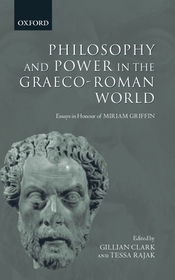
Philosophy and Power in the Graeco-Roman World
Essays in Honour of Miriam Griffin
-
10% KEDVEZMÉNY?
- A kedvezmény csak az 'Értesítés a kedvenc témákról' hírlevelünk címzettjeinek rendeléseire érvényes.
- Kiadói listaár GBP 197.50
-
89 171 Ft (84 925 Ft + 5% áfa)
Az ár azért becsült, mert a rendelés pillanatában nem lehet pontosan tudni, hogy a beérkezéskor milyen lesz a forint árfolyama az adott termék eredeti devizájához képest. Ha a forint romlana, kissé többet, ha javulna, kissé kevesebbet kell majd fizetnie.
- Kedvezmény(ek) 10% (cc. 8 917 Ft off)
- Kedvezményes ár 80 254 Ft (76 433 Ft + 5% áfa)
Iratkozzon fel most és részesüljön kedvezőbb árainkból!
Feliratkozom
89 171 Ft

Beszerezhetőség
Megrendelésre a kiadó utánnyomja a könyvet. Rendelhető, de a szokásosnál kicsit lassabban érkezik meg.
Why don't you give exact delivery time?
A beszerzés időigényét az eddigi tapasztalatokra alapozva adjuk meg. Azért becsült, mert a terméket külföldről hozzuk be, így a kiadó kiszolgálásának pillanatnyi gyorsaságától is függ. A megadottnál gyorsabb és lassabb szállítás is elképzelhető, de mindent megteszünk, hogy Ön a lehető leghamarabb jusson hozzá a termékhez.
A termék adatai:
- Kiadó OUP Oxford
- Megjelenés dátuma 2002. augusztus 29.
- ISBN 9780198299905
- Kötéstípus Keménykötés
- Terjedelem368 oldal
- Méret 224x146x23 mm
- Súly 530 g
- Nyelv angol 0
Kategóriák
Rövid leírás:
This volume in honour of Miriam Griffin brings together seventeen international specialists. Their essays range from Socrates to late antiquity, with a particular focus on Cicero. Subjects covered include the Stoics and Cynics, Roman law, the formulation of imperial power, Jews and Christians, 'performance philosophy', Augustine, late Platonism, and women philosophers.
TöbbHosszú leírás:
Miriam Griffin is unrivalled as a bridge-builder between historians of the Graeco-Roman world and students of its philosophies. This volume in her honour brings togetherseventeen international specialists. Their essays range from Socrates to late antiquity, extending to Diogenes, Cicero, Pliny the Elder, Marcus Aurelius, the Second Sophistic, Ulpian, Augustine, the Neoplatonist tradition, women philosophers, provision for basic human needs, the development of law, the formulation of imperial power, and the interpretation of Judaism and early Christianity. Emperors and drop-outs, media stars and administrators, top politicians and abstruse professionals, even ordinary citizens in their epitaphs, were variously called philosophers. Philosophy could offer those in power moral support or confrontation, a language for making choices or an intellectual diversion, but they might disregard philosophy and get on with the exercise of power. 'Philosophy' means 'love of wisdom', but what was the power of philosophy?
... delightful ... cannot fail to interest and impress ... there is much for anyone interested in the exercise of power in the Greco-Roman world. This is an elegant volume and a worthy presentation to a distinguished and sympathetic teacher and scholar.
Tartalomjegyzék:
Introduction: Philosophy and Power
Did Socrates agree to obey the laws of Athens?
The Worth of Human Dignity: Two Tensions in Stoic Cosmpolitanism
Cicero and the Defining of the Ius Civile
Government and Law: Ulpian, a Philosopher in Politics?
Academic Therapy: Philo of Larissa and Cicero's Project in the Tusculans
Beyond Comparison: M. Sergius, fortunae victor
Women, Power, and Philosophy at Rome and Beyond
Philosophy in the Second Sophistic
Cicero: A Man of Letters - in Politics
Deus or Divus: The Genesis of Roman Terminology for Deified Emperors and a Philosopher's Contribution
Arcanum imperii: The Powers of Augustus
An Emperor is Made: Senatorial Politics and Trajan's Adoption by Nerva in 97
'Foolishness to the Greeks': Jews and Christians in the Public Life of the Empire
Old Philosophy and New Power: Cicero in fifth-century North Africa
Philosophy and power: The Creation of Orthodoxy in Neoplatonism
Ancient Philosophers

