

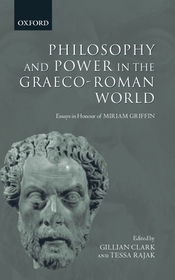
Philosophy and Power in the Graeco-Roman World
Essays in Honour of Miriam Griffin
- Publisher's listprice GBP 197.50
-
89 171 Ft (84 925 Ft + 5% VAT)
The price is estimated because at the time of ordering we do not know what conversion rates will apply to HUF / product currency when the book arrives. In case HUF is weaker, the price increases slightly, in case HUF is stronger, the price goes lower slightly.
- Discount 10% (cc. 8 917 Ft off)
- Discounted price 80 254 Ft (76 433 Ft + 5% VAT)
Subcribe now and take benefit of a favourable price.
Subscribe
89 171 Ft

Availability
printed on demand
Why don't you give exact delivery time?
Delivery time is estimated on our previous experiences. We give estimations only, because we order from outside Hungary, and the delivery time mainly depends on how quickly the publisher supplies the book. Faster or slower deliveries both happen, but we do our best to supply as quickly as possible.
Product details:
- Publisher OUP Oxford
- Date of Publication 29 August 2002
- ISBN 9780198299905
- Binding Hardback
- No. of pages368 pages
- Size 224x146x23 mm
- Weight 530 g
- Language English 0
Categories
Short description:
This volume in honour of Miriam Griffin brings together seventeen international specialists. Their essays range from Socrates to late antiquity, with a particular focus on Cicero. Subjects covered include the Stoics and Cynics, Roman law, the formulation of imperial power, Jews and Christians, 'performance philosophy', Augustine, late Platonism, and women philosophers.
MoreLong description:
Miriam Griffin is unrivalled as a bridge-builder between historians of the Graeco-Roman world and students of its philosophies. This volume in her honour brings togetherseventeen international specialists. Their essays range from Socrates to late antiquity, extending to Diogenes, Cicero, Pliny the Elder, Marcus Aurelius, the Second Sophistic, Ulpian, Augustine, the Neoplatonist tradition, women philosophers, provision for basic human needs, the development of law, the formulation of imperial power, and the interpretation of Judaism and early Christianity. Emperors and drop-outs, media stars and administrators, top politicians and abstruse professionals, even ordinary citizens in their epitaphs, were variously called philosophers. Philosophy could offer those in power moral support or confrontation, a language for making choices or an intellectual diversion, but they might disregard philosophy and get on with the exercise of power. 'Philosophy' means 'love of wisdom', but what was the power of philosophy?
... delightful ... cannot fail to interest and impress ... there is much for anyone interested in the exercise of power in the Greco-Roman world. This is an elegant volume and a worthy presentation to a distinguished and sympathetic teacher and scholar.
Table of Contents:
Introduction: Philosophy and Power
Did Socrates agree to obey the laws of Athens?
The Worth of Human Dignity: Two Tensions in Stoic Cosmpolitanism
Cicero and the Defining of the Ius Civile
Government and Law: Ulpian, a Philosopher in Politics?
Academic Therapy: Philo of Larissa and Cicero's Project in the Tusculans
Beyond Comparison: M. Sergius, fortunae victor
Women, Power, and Philosophy at Rome and Beyond
Philosophy in the Second Sophistic
Cicero: A Man of Letters - in Politics
Deus or Divus: The Genesis of Roman Terminology for Deified Emperors and a Philosopher's Contribution
Arcanum imperii: The Powers of Augustus
An Emperor is Made: Senatorial Politics and Trajan's Adoption by Nerva in 97
'Foolishness to the Greeks': Jews and Christians in the Public Life of the Empire
Old Philosophy and New Power: Cicero in fifth-century North Africa
Philosophy and power: The Creation of Orthodoxy in Neoplatonism
Ancient Philosophers

