

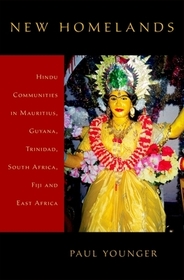
New Homelands
Hindu Communities in Mauritius, Guyana, Trinidad, South Africa, Fiji, and East Africa
-
10% KEDVEZMÉNY?
- A kedvezmény csak az 'Értesítés a kedvenc témákról' hírlevelünk címzettjeinek rendeléseire érvényes.
- Kiadói listaár GBP 100.00
-
47 775 Ft (45 500 Ft + 5% áfa)
Az ár azért becsült, mert a rendelés pillanatában nem lehet pontosan tudni, hogy a beérkezéskor milyen lesz a forint árfolyama az adott termék eredeti devizájához képest. Ha a forint romlana, kissé többet, ha javulna, kissé kevesebbet kell majd fizetnie.
- Kedvezmény(ek) 10% (cc. 4 778 Ft off)
- Kedvezményes ár 42 998 Ft (40 950 Ft + 5% áfa)
Iratkozzon fel most és részesüljön kedvezőbb árainkból!
Feliratkozom
47 775 Ft

Beszerezhetőség
Megrendelésre a kiadó utánnyomja a könyvet. Rendelhető, de a szokásosnál kicsit lassabban érkezik meg.
Why don't you give exact delivery time?
A beszerzés időigényét az eddigi tapasztalatokra alapozva adjuk meg. Azért becsült, mert a terméket külföldről hozzuk be, így a kiadó kiszolgálásának pillanatnyi gyorsaságától is függ. A megadottnál gyorsabb és lassabb szállítás is elképzelhető, de mindent megteszünk, hogy Ön a lehető leghamarabb jusson hozzá a termékhez.
A termék adatai:
- Kiadó OUP USA
- Megjelenés dátuma 2009. december 10.
- ISBN 9780195391640
- Kötéstípus Keménykötés
- Terjedelem304 oldal
- Méret 157x236x25 mm
- Súly 567 g
- Nyelv angol
- Illusztrációk 52 black and white halftones; 6 line illustrations 0
Kategóriák
Rövid leírás:
When the colonial slave trade, and then slavery itself, were abolished early in the 19th century, the British empire brazenly set up a new system of trade using Indian rather than African laborers. The new system of 'indentured' labor was supposed to be different from slavery because the indenture, or contract, was written for an initial period of five years and involved fixed wages and some specified conditions of work. In this fieldwork-based study, Paul Younger looks at the present day descendents of these workers and their post-indenture societies in Mauritius, Guyana, Trinidad, South Africa, Fiji, and East Africa. He finds that they still cling to the fact that it was an arbitrary British decision that took them there and made the society pluralistic. This plurality seems to require them to search their memory for a distinctive religious tradition that they can pass on to their children
TöbbHosszú leírás:
When the colonial slave trade, and then slavery itself, were abolished early in the 19th century, the British empire brazenly set up a new system of trade using Indian rather than African laborers. The new system of "indentured" labor was supposed to be different from slavery because the indenture, or contract, was written for an initial period of five years and involved fixed wages and some specified conditions of work. From the workers' point of view, the one redeeming feature of the system was that most of their workmates spoke their language and came from the same area of India. Because this allowed them to develop some sense of community, by the end of the initial five years most of the Indian laborers chose to stay in the land to which they had been taken. In time that land became the place in which they joined with others to build a new homeland. In this fieldwork-based study, Paul Younger looks at the present day descendents of these workers and their post-indenture societies in Mauritius, Guyana, Trinidad, South Africa, Fiji, and East Africa. He finds that they still cling to the fact that it was an arbitrary British decision that took them there and made the society pluralistic. This plurality seems to require them to search their memory for a distinctive religious tradition that they can pass on to their children. They know that there was a loss of culture involved in their move to these locations and consider it important to recover from that loss. But they are also intensely proud of their new identity, and insist that they have established a new religious tradition in their new homeland. For generations, says Younger, these people had struggled in their situation and now they had come up with a sense of community and purpose and were prepared to make the historical claim that they had developed an appropriate religious tradition for their specific community.
Younger's new book provides muc-needed date and a useful analysis of some of the oldest Indian-oridin Hindu communities living outside of India.
Tartalomjegyzék:
Introduction: New Homelands
Mauritius: A Parallel Society
Guyana: Invented Traditions
Trinidad: Ethnic Religion
South Africa: Reform Religion
Fiji: A Segregated Society
East Africa: Caste Religion
Conclusion

