

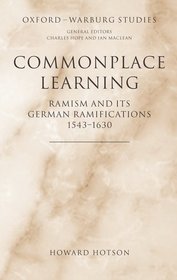
Commonplace Learning
Ramism and its German Ramifications, 1543-1630
Sorozatcím: Oxford-Warburg Studies;
-
10% KEDVEZMÉNY?
- A kedvezmény csak az 'Értesítés a kedvenc témákról' hírlevelünk címzettjeinek rendeléseire érvényes.
- Kiadói listaár GBP 267.50
-
120 776 Ft (115 025 Ft + 5% áfa)
Az ár azért becsült, mert a rendelés pillanatában nem lehet pontosan tudni, hogy a beérkezéskor milyen lesz a forint árfolyama az adott termék eredeti devizájához képest. Ha a forint romlana, kissé többet, ha javulna, kissé kevesebbet kell majd fizetnie.
- Kedvezmény(ek) 10% (cc. 12 078 Ft off)
- Kedvezményes ár 108 699 Ft (103 523 Ft + 5% áfa)
Iratkozzon fel most és részesüljön kedvezőbb árainkból!
Feliratkozom
120 776 Ft

Beszerezhetőség
Megrendelésre a kiadó utánnyomja a könyvet. Rendelhető, de a szokásosnál kicsit lassabban érkezik meg.
Why don't you give exact delivery time?
A beszerzés időigényét az eddigi tapasztalatokra alapozva adjuk meg. Azért becsült, mert a terméket külföldről hozzuk be, így a kiadó kiszolgálásának pillanatnyi gyorsaságától is függ. A megadottnál gyorsabb és lassabb szállítás is elképzelhető, de mindent megteszünk, hogy Ön a lehető leghamarabb jusson hozzá a termékhez.
A termék adatai:
- Kiadó OUP Oxford
- Megjelenés dátuma 2007. január 25.
- ISBN 9780198174301
- Kötéstípus Keménykötés
- Terjedelem360 oldal
- Méret 223x146x26 mm
- Súly 536 g
- Nyelv angol
- Illusztrációk 10 charts and maps 0
Kategóriák
Rövid leírás:
This first contextualized study of the rich tradition of Ramism has wide-ranging implications for the intellectual, cultural, and social histories not only of the Holy Roman Empire but also of the entire Protestant world in the crucial decades immediately preceding the advent of the 'new philosophy' in the mid-seventeenth century.
TöbbHosszú leírás:
Ramism was the most controversial pedagogical movement to sweep through the Protestant world in the latter sixteenth century. While its origins in France, its impact in colonial America, and its influence in England, Scotland, and Ireland have been studied in detail, its uniquely warm reception in central Europe - where the great majority of posthumous reprintings of Ramus's work appeared - has never been synoptically studied. This book, the first contextualized study of this rich tradition, therefore has wide-ranging implications for the intellectual, cultural, and social histories not only of the Holy Roman Empire but also of the entire Protestant world in the crucial decades immediately preceding the advent of the 'new philosophy' in the mid-seventeenth century.
Brilliantly written, perfectly constructed, Hotson's work reads like a novel...a rich and convincing panorama which will serve from this point onward as an indispensable landmark for all future research in a particularly elusive and complex field of study
Tartalomjegyzék:
First-generation Ramism
1. Introduction: the earliest German Ramism
Ramism in Germany: a neglected tradition
Ramism and Calvinism: an overworked explanation
The spread of Ramism in north-western Germany: a fresh start
2. Foundations: Ramism in German context, 1543-1600
The rudiments of Ramism
Ramism and humanism, c.1580-1600
Ramism in Hanseatic cities and imperial counties
Second-generation semi-Ramism
3. Institutionalisation: semi-Ramism in Reformed academies, 1580-1600
Adaptation: the advent of Philippo-Ramism
Confessionalisation: Ramism and Calvinism revisited
Expansion: Ramism and the encyclopaedia
4. Adaptation: Post-Ramist methods in Reformed universities, 1590-1613
Beyond Philippo-Ramism: Casmann, Timpler, Keckermann, and Alsted
'Methodical Peripateticism': Heidelberg and Keckermann's systema, 1590-1601
Precursor to the Encyclopaedia: Danzig and Keckermann's Systema systematum, 1602-13
Third-generation post-Ramist eclecticism
5. Compilation: Alsted's Cursus philosophici encyclopaedia, 1609-20
Form: the Encyclopaedia as systema systematum
Composition: the Encyclopaedia as bibliotheca universalis locorum communium
Matter: the Encyclopaedia as bibliotheca philosophica
6. Culmination: Alsted's Encyclopaedia septem tomis distincta, 1620-30
Synthesis: the Encyclopaedia as systema harmonicum
Expansion: from Cursus philosophici encyclopaedia (1620) to Encyclopedia omnium disciplinarum (1630)
Dissolution: the Encyclopaedia as Farragines disciplinarum
7. Interim conclusions
Destruction and further ramification, 1622-70
The common principles: means and ends of the German post-Ramist tradition
Select Bibliography
Index

