

- Publisher's listprice GBP 267.50
-
120 776 Ft (115 025 Ft + 5% VAT)
The price is estimated because at the time of ordering we do not know what conversion rates will apply to HUF / product currency when the book arrives. In case HUF is weaker, the price increases slightly, in case HUF is stronger, the price goes lower slightly.
- Discount 10% (cc. 12 078 Ft off)
- Discounted price 108 699 Ft (103 523 Ft + 5% VAT)
Subcribe now and take benefit of a favourable price.
Subscribe
120 776 Ft

Availability
printed on demand
Why don't you give exact delivery time?
Delivery time is estimated on our previous experiences. We give estimations only, because we order from outside Hungary, and the delivery time mainly depends on how quickly the publisher supplies the book. Faster or slower deliveries both happen, but we do our best to supply as quickly as possible.
Product details:
- Publisher OUP Oxford
- Date of Publication 25 January 2007
- ISBN 9780198174301
- Binding Hardback
- No. of pages360 pages
- Size 223x146x26 mm
- Weight 536 g
- Language English
- Illustrations 10 charts and maps 0
Categories
Short description:
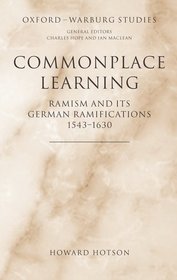
This first contextualized study of the rich tradition of Ramism has wide-ranging implications for the intellectual, cultural, and social histories not only of the Holy Roman Empire but also of the entire Protestant world in the crucial decades immediately preceding the advent of the 'new philosophy' in the mid-seventeenth century.
MoreLong description:
Ramism was the most controversial pedagogical movement to sweep through the Protestant world in the latter sixteenth century. While its origins in France, its impact in colonial America, and its influence in England, Scotland, and Ireland have been studied in detail, its uniquely warm reception in central Europe - where the great majority of posthumous reprintings of Ramus's work appeared - has never been synoptically studied. This book, the first contextualized study of this rich tradition, therefore has wide-ranging implications for the intellectual, cultural, and social histories not only of the Holy Roman Empire but also of the entire Protestant world in the crucial decades immediately preceding the advent of the 'new philosophy' in the mid-seventeenth century.
Brilliantly written, perfectly constructed, Hotson's work reads like a novel...a rich and convincing panorama which will serve from this point onward as an indispensable landmark for all future research in a particularly elusive and complex field of study
Table of Contents:
First-generation Ramism
1. Introduction: the earliest German Ramism
Ramism in Germany: a neglected tradition
Ramism and Calvinism: an overworked explanation
The spread of Ramism in north-western Germany: a fresh start
2. Foundations: Ramism in German context, 1543-1600
The rudiments of Ramism
Ramism and humanism, c.1580-1600
Ramism in Hanseatic cities and imperial counties
Second-generation semi-Ramism
3. Institutionalisation: semi-Ramism in Reformed academies, 1580-1600
Adaptation: the advent of Philippo-Ramism
Confessionalisation: Ramism and Calvinism revisited
Expansion: Ramism and the encyclopaedia
4. Adaptation: Post-Ramist methods in Reformed universities, 1590-1613
Beyond Philippo-Ramism: Casmann, Timpler, Keckermann, and Alsted
'Methodical Peripateticism': Heidelberg and Keckermann's systema, 1590-1601
Precursor to the Encyclopaedia: Danzig and Keckermann's Systema systematum, 1602-13
Third-generation post-Ramist eclecticism
5. Compilation: Alsted's Cursus philosophici encyclopaedia, 1609-20
Form: the Encyclopaedia as systema systematum
Composition: the Encyclopaedia as bibliotheca universalis locorum communium
Matter: the Encyclopaedia as bibliotheca philosophica
6. Culmination: Alsted's Encyclopaedia septem tomis distincta, 1620-30
Synthesis: the Encyclopaedia as systema harmonicum
Expansion: from Cursus philosophici encyclopaedia (1620) to Encyclopedia omnium disciplinarum (1630)
Dissolution: the Encyclopaedia as Farragines disciplinarum
7. Interim conclusions
Destruction and further ramification, 1622-70
The common principles: means and ends of the German post-Ramist tradition
Select Bibliography
Index

