

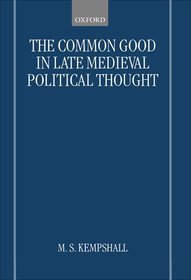
The Common Good in Late Medieval Political Thought
- Publisher's listprice GBP 252.50
-
114 003 Ft (108 575 Ft + 5% VAT)
The price is estimated because at the time of ordering we do not know what conversion rates will apply to HUF / product currency when the book arrives. In case HUF is weaker, the price increases slightly, in case HUF is stronger, the price goes lower slightly.
- Discount 10% (cc. 11 400 Ft off)
- Discounted price 102 603 Ft (97 718 Ft + 5% VAT)
Subcribe now and take benefit of a favourable price.
Subscribe
114 003 Ft

Availability
printed on demand
Why don't you give exact delivery time?
Delivery time is estimated on our previous experiences. We give estimations only, because we order from outside Hungary, and the delivery time mainly depends on how quickly the publisher supplies the book. Faster or slower deliveries both happen, but we do our best to supply as quickly as possible.
Product details:
- Publisher OUP Oxford
- Date of Publication 20 May 1999
- ISBN 9780198207160
- Binding Hardback
- No. of pages412 pages
- Size 242x162x27 mm
- Weight 787 g
- Language English 0
Categories
Short description:
This book reassesses the impact of Aristotle's moral and political philosophy on medieval scholastic thought. It examines the relationship between the common good and the individual good, and between the authority of the Church and the authority of the temporal ruler. The result is a major reinterpretation of the emergence of a secular theory of the state in the late thirteenth and early fourteenth centuries.
MoreLong description:
This study offers a major reinterpretation of medieval political thought by examining one of its most fundamental ideas. If it was axiomatic that the goal of human society should be the common good, then this notion presented at least two conceptual alternatives. Did it embody the highest moral ideals of happiness and the life of virtue, or did it represent the more pragmatic benefits of peace and material security? Political thinkers from Thomas Aquinas to William of Ockham answered this question in various contexts. In theoretical terms, they were reacting to the rediscovery of Aristotle's Politics and Ethics, an event often seen as pivotal in the history of political thought. On a practical level, they were faced with pressing concerns over the exercise of both temporal and ecclesiastical authority - resistance to royal taxation and opposition to the jurisdiction of the pope. In establishing the connections between these different contexts, The Common Good questions the identification of Aristotle as the primary catalyst for the emergence of 'the individual' and a 'secular' theory of the state. Through a detailed exposition of scholastic political theology, it argues that the roots of any such developments should be traced, instead, to Augustine and the Bible.
This detailed analysis of the common good ... in scholastic philosophical and theological discourse throws critical light on the history of political ideas.
Table of Contents:
Albertus Magnus: Aristotle and the Common Good
Albertus Magnus: Common Good and Common Benefit
Thomas Aquinas: Metaphysics and Hierarchy
Thomas Aquinas: Love, Justice, and Virtue
The Life of Virtue: Giles of Rome's De Regimine Principum
Henry of Ghent: Self-Love and Inclusion
Henry of Ghent: Authority, Obedience, and Resistance
Godfrey of Fontaines: Love, Justice, and Virtue
Godfrey of Fontaines: Authority, Obedience, and Resistance
The Life of Virtue: Giles of Rome, James of Viterbo, and John of Paris
Remigio dei Girolami: The Order of Love
Remigio dei Girolami: Peace and Order
Conclusion
Bibliography

