

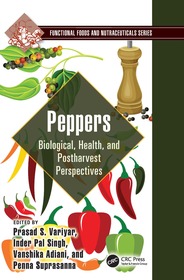
Peppers
Biological, Health, and Postharvest Perspectives
Series: Functional Foods and Nutraceuticals;
- Publisher's listprice GBP 180.00
-
81 270 Ft (77 400 Ft + 5% VAT)
The price is estimated because at the time of ordering we do not know what conversion rates will apply to HUF / product currency when the book arrives. In case HUF is weaker, the price increases slightly, in case HUF is stronger, the price goes lower slightly.
- Discount 20% (cc. 16 254 Ft off)
- Discounted price 65 016 Ft (61 920 Ft + 5% VAT)
- Discount is valid until: 30 June 2026
Subcribe now and take benefit of a favourable price.
Subscribe
73 143 Ft

Availability
Estimated delivery time: In stock at the publisher, but not at Prospero's office. Delivery time approx. 3-5 weeks.
Not in stock at Prospero.
Why don't you give exact delivery time?
Delivery time is estimated on our previous experiences. We give estimations only, because we order from outside Hungary, and the delivery time mainly depends on how quickly the publisher supplies the book. Faster or slower deliveries both happen, but we do our best to supply as quickly as possible.
Product details:
- Edition number 1
- Publisher CRC Press
- Date of Publication 8 November 2024
- ISBN 9781032453538
- Binding Hardback
- No. of pages302 pages
- Size 254x178 mm
- Weight 740 g
- Language English
- Illustrations 40 Illustrations, black & white; 32 Illustrations, color; 2 Halftones, black & white; 16 Halftones, color; 38 Line drawings, black & white; 16 Line drawings, color; 27 Tables, black & white 552
Categories
Short description:
The book highlights the advancements made in chemistry, biochemistry and biosynthesis of bioactive compounds of peppers. Impact of climate change and processing methods on the bioactive compounds and a consequent effect on health promoting constituents will be covered in the various chapters.
MoreLong description:
There is an increased awareness on the relevance of nutraceutical and functional foods as alternatives to harmful synthetic additives used in industry. Different peppers, with an abundance of bioactive compounds, are highlighted in this book, which provides a comprehensive evaluaton of their importance as nutraceutical and functional foods to all stakeholders in the agri-food and pharmaceutical industries. Peppers: Biological, Health, and Postharvest Perspectives is a valuable addition to the existing information resource on peppers.
Key features:
- Highlights the advancements made in biodiversity, biochemistry and biosynthesis of bioactive compounds of peppers.
- Reviews the effects of processing methods on the quality of peppers to facilitate further research and development of foods having pepper as an essential nutritional component.
- Provides help in selecting better processing methods for the management of nutritional attributes and health benefits of peppers.
The book provides a blend of basic and advanced information for postgraduate students, researchers and scientists
MoreTable of Contents:
Preface xii
The Editors xiii
List of Contributors xiv
Chapter 1 Peppers—an Overview on The Bioactives and their Nutritional, Functional Properties and Post-Harvest Processing 1
Prasad S. Variyar and Penna Suprasanna
1.1 Introduction 1
1.2 Capsicum 2
1.3 Chemical Composition 3
1.4 Capsaicinoids and Carotenes: Biosynthesis and Genetic Regulation 4
1.5 Quality Evaluation of Peppers 6
1.6 Effect of Pre- and Post-Harvest Factors on the Quality of Pepper Fruits 7
1.7 Nutritional and Functional Properties 9
1.8 Medicinal and Health Benefits 9
1.8.1 Anti-Inflammatory Effects 9
1.8.2 Cardiovascular Health 9
1.8.3 Immunity Booster 10
1.8.4 Alleviates Prostate Cancer 10
1.8.5 Prevention of Stomach Ulcers 10
1.8.6 Reduces Risk of Type 2 Diabetes and Obesity 10
1.8.7 Antirhinitis Agent 10
1.9 Novel and Diverse Products of Pepper 10
1.10 Post-Harvest Processing for Improved Production of Bioactive Compounds 11
1.11 Conclusions 12
References 12
Chapter 2 Genetic Diversity for Fruit Quality Traits in Chilli (Capsicum spp.) 16
Pavani, N., Satyaprakash Barik, Naresh Ponnam and Madhavi Reddy K
2.1 Introduction 16
2.2 Pepper Diversity, Domestication and Conservation 17
2.3 Hybridization and Crossability 19
2.4 Genetic Resources and Breeding of Peppers for Industrial Use 19
2.5 Conclusions 21
References 21
Chapter 3 Contribution of Interspecific Hybridization for Improvement in Quality and Productivity in Pepper 25
Kazım Mavi
3.1 Introduction 25
3.2 Systematic Advances in Interspecific Hybridization 27
3.3 Problems and Solutions in Interspecific Hybridization 30
3.3.1 Hybridization Barriers 30
3.3.2 Post-Fertilization Abnormalities and Embryo Rescue 30
3.3.3 Infertility (Sterility) in Interspecific Hybrids 31
3.4 Detection of Interspecific Hybrids by Molecular Techniques 33
3.5 Quality Development Through Interspecific Hybridization 33
3.6 Conclusion and Future Perspectives 35
References 36
Chapter 4 Chemical Diversity and Functionality of Capsaicinoids 40
Inder Pal Singh, Nobuyuki Mase, Ankur Kumar Tanwar, Neha Sengar and Olivia Chatterjee
4.1 Introduction 41
4.1.1 Capsaicinoids 41
4.1.2 Capsiates (Natural Capsaicin Analogues) 42
4.1.3 Biosynthesis of Capsaicinoids 43
4.1.4 Capsaicin 43
4.1.5 Metabolism of Capsaicin 44
4.2 Pharmacological Activity of Capsaicinoids 45
4.2.1 Anti-Inflammatory Activity 45
4.2.2 Antidiabetic Activity 46
4.2.3 Antioxidant Activity 47
4.2.4 CNS Activity 47
4.2.5 Cardiovascular Activity 48
4.2.6 Chemopreventive Activity 48
4.2.7 Hypocholesterolemic and Hypolipidemic Activity 49
4.2.8 Antiulcer Property 50
4.3 Structure Activity Relationship (SAR) of Capsaicinoids 50
4.3.1 Substitution in A Region 50
4.3.2 Substitution in B Region 53
4.3.3 Substitution in C Region 55
4.4 Conclusion 59
References 60
Chapter 5 Analytical Methods for Capsaicinoids and Other Bioactive Metabolites 65
Inder Pal Singh, Dharmistha Rajput and Debanjan Chatterjee 5.1 Introduction 65
5.1 Introduction 65
5.2 Extraction Techniques 67
5.3.1 Chromatographic Techniques 71
5.3.2 Spectroscopic Techniques 74
5.3.3 Hyphenated Techniques 76
5.4 Summary 78
References 78
Chapter 6 Transcriptomics of Chili Pepper Fruit with Emphasis on the Carotenoid Biosynthetic Pathway 80
Maria Guadalupe Villa-Rivera, Octavio Martínez and Neftalí Ochoa-Alejo
6.1 Introduction 80
6.2 Applications of Transcriptomic Analysis in Chili Pepper 81
6.2.1 Transcriptomic Analysis in the Study of Bioactive Compounds 83
6.3 Transcriptomics and Transcriptional Regulation of the Carotenoid
Biosynthetic Pathway 84
6.3.1 Carotenoid Biosynthesis Pathway in Chili Pepper 84
6.3.2 Transcriptional Regulation of Carotenoid Biosynthetic Pathway 87
6.4 Gene Functional Networks of Carotenoid Biosynthetic Pathway in Chili Pepper 88
6.4.1 Time Expression Profiles of Genes Involved in Carotenoid Biosynthesis in Chili Pepper 88
6.4.2 Location of Putative Binding Sites of Transcription Factors Candidates on Structural Genes 92
6.5 Conclusions and Future Perspectives 93
References 94
Chapter 7 Chemistry and Post-Harvest Processing Technologies of Peppers (Capsicum spp.) 98
Filipe Kayodè Felisberto dos Santos, Rayssa Ribeiro, Karine Sayuri Lima Miki, Barbara Elisabeth Teixeira-Costa and Valdir Florêncio da Veiga Júnior
7.1 Introduction 98
7.2 Peppers and Their Chemical Complexity 99
7.2.1 Capsaicinoids 99
7.2.2 Carotenoids 100
7.2.3 Flavonoids 102
7.3 Update on Peppers’ Medicinal Properties and Applications 102
7.4 Physical, Chemical and Non-Destructive Post-Harvest Technologies 105
7.4.1 Dehydration 105
7.4.2 Freezing 106
7.4.3 Modified Atmosphere Packaging 106
7.4.4 Application of Edible Coatings 107
7.5 Trends and Perspectives 108
References 109
Chapter 8 Capsaicin and Capsaicinoids—Sources, Characteristics, Isolation, Food and Medical Uses 113
Talía Hernández-Pérez and Octavio Paredes-López
8.1 Introduction 113
8.2 Main Characteristics of Capsaicinoids 114
8.3 Pungency 115
8.4 Non-Pungent Compounds 116
8.5 Nutraceutical and Medical Potential of Capsaicin 117
8.5.1 Antiobesity Effect 117
8.5.2 Analgesic Potential 119
8.5.3 Anticancer Activity 120
8.5.4 Urinary System Disorders 120
8.6 Conclusions and Future Perspectives 121
8.7 Acknowledgements 122
References 122
Chapter 9 Medicinal Bioactive Secondary Metabolites of Indian Chili (Capsicum sp.) 126
Debosree Ghosh, Partha Sarathi Singha and Ramkrishna Ghosh
9.1 Introduction 126
9.2 Secondary Metabolites as Bioactive Phytocompounds 127
9.3 Secondary Metabolites of Indian Chilies and Their Medicinal Properties 128
9.3.1 Alkaloids from Chili 129
9.3.2 Terpenoids 129
9.3.3 Terpenoid-Alkaloids 130
9.3.4 Polyphenols 130
9.4 Conclusions and Future Perspectives 133
9.5 Acknowledgement 134
References 134
Chapter 10 Recent Trends in Pepper-Derived Products for Food Matrices 138
Somnath Basak and Rekha S. Singhal
10.1 Introduction 138
10.2 Oleoresins and Essential Oils 139
10.3 Inclusion Complexes 141
10.4 Essential Oil–Based Emulsions 144
10.5 Essential Oil–Based Powder 145
10.6 Pepper-Based Beverage 145
10.7 Fermented Whole Peppers 146
10.8 Pepper-Based Protein 150
10.9 Summary 150
References 151
Chapter 11 Capsaicinoids from Sustainable Capsicum Production for Nutraceutical Development - 155
Mursleen Yasin, Michelle Donovan-Mak, Zhong-Hua Chen and Sunil K. Panchal
11.1 Introduction 155
11.2 The Genus Capsicum 156
11.3 Global Production of Capsicums and Chillies 157
11.4 The Science of Pungency in Capsicum 158
11.5 Capsaicinoids 159
11.6 Production of Capsaicinoids 160
11.7 Factors Affecting Capsaicinoid Production 161
11.7.1 Genetics 162
11.7.2 Light 163
11.7.3 Water Availability 163
11.7.4 Mineral Nutrients 164
11.7.5 Temperature 164
11.8 Growth and Developmental Stages 164
11.9 Properties of Capsaicinoids and Capsinoids 165
11.10 Extraction of Capsaicinoids 166
11.10.1 Methods of Extraction 166
11.11 Properties of Capsaicin 168
11.12 Postharvest Technology to Increase Production of Capsaicinoids 169
11.13 Metabolomics in Capsicums 170
11.13.1 Carotenoids 171
11.13.2 Phenolics 172
11.13.3 Ascorbic Acid (Vitamin C) 172
11.14 Solutions Toward Reducing Capsicum and Chilli Waste 173
11.15 Sustainable Use of Waste of Capsicum Crops 173
11.16 Conclusions and Future Perspectives 174
References 174
Chapter 12 Post-Harvest Handling and Processing of Green and Red Indian Chillies 184
A.J. Sachin, P. Preethi, S.V.R. Reddy and P. Naresh
12.1 Introduction 185
12.2 Green Chillies 185
12.2.1 Harvesting, Packaging, and Transportation 185
12.2.2 Processing and Value Addition 186
12.3 Dry Chillies 187
12.3.1 Drying 187
12.3.2 Packaging and Storage 190
12.3.3 Sorting and Grading 191
12.4 Conclusion 191
References 191
Chapter 13 Influence of Packaging on Postharvest Quality of Peppers 194
Komal Sonawane and Ramanand Jagtap
13.1 Introduction 194
13.2 Pepper Packaging 195
13.2.1 Pepper Characteristics 195
13.2.2 Contamination and Flavor Preservation in Pepper Packaging: From Harvesting to Processing 196
13.2.3 Oxygen Interaction with Packaging Material 196
13.2.4 Interaction of Pepper Ingredients with Packaging Material 197
13.3 Dependability of Oxygen Permeation on Structure of Polymeric Packaging Material 198
13.4 Types of Packaging Material 199
13.5 Recent Advances in Pepper Packaging 202
13.5.1 Single-Layer and Double-Layer Packaging 202
13.5.2 Multilayer Packaging 203
13.6 Disposal Challenges for Multilayer System 204
13.7 Active Packaging Systems .206
13.8 Modified Atmosphere Packaging (MAP) 206
13.9 Sustainable and Eco-Friendly Packaging 207
13.9.1 Biocompostable Packaging 208
13.10 Intelligent Packaging 208
13.11 Innovative Packaging Designs 209
13.12 Nanohybrid-Based Biocomposites 210
13.13 Packaging Design and Structure 211
13.14 Storage Duration 211
13.15 Conclusions 212
References 213
Chapter 14 Pepper Fixed Oil: Novel Source of Oil-Based Nutraceuticals 219
Ajay W. Tumaney, Vallamkondu Manasa, Palak Daga and Salony Raghunath Vaishnav
14.1 Introduction 219
14.1.1 Overview of Pepper Production 219
14.1.2 Health Benefits of Pepper Oil 220
14.2 Pepper Oils 223
14.2.1 Total Oil 224
14.2.2 Essential Oil 225
14.2.3 Fixed Oil 225
14.2.4 Oleoresins 226
14.3 Oil Nutraceuticals 226
14.3.1 Polyphenols 227
14.3.2 Tocopherols 227
14.3.3 Phytosterols 228
14.3.4 Antioxidants 229
14.4 Conclusion 230
References 230
Chapter 15 Effect of Newer Non-Thermal Processing 235
Admajith M. Kaimal, Amrutha M. Kaimal and Rekha S. Singhal
15.1 Introduction 235
15.1.1 A Brief Overview of Capsicum Production 236
15.1.2 Post-Harvest Scenario and Losses 236
15.2 Impact of Paprika Constituents During Storage 237
15.2.1 Proximate Composition 237
15.2.2 Vitamins 239
15.2.3 Polyphenols 239
15.2.4 Carotenoids 239
15.2.5 Capsaicinoids 240
15.3 Non-Thermal Processing of Paprika 240
15.3.1 High-Pressure Processing (HPP)- 241
15.3.2 Pulsed Electric Field Processing (PEF) 244
15.3.3 Pulsed Light Processing (PL) 245
15.3.4 Ozone 246
15.3.5 Non-Thermal Plasma 248
15.3.6 Irradiation 250
15.3.7 Ultrasound 251
15.3.8 Other Novel Technologies 251
15.3.9 Synergistic Technologies 252
15.4 Effect of Non-Thermal Process on Paprika Constituents 253
15.4.1 Proximate Composition 253
15.4.2 Polyphenols 256
15.4.3 Carotenoids 257
15.4.4 Capsaicinoids 257
15.5 Food Safety and Regulatory Challenges 257
15.6 Future Prospects 258
15.7 Conclusions - 258
References 258
Chapter 16 Adulteration and Authenticity Testing of Chilli 264
B. Sasikumar
16.1 Introduction 264
16.2 Adulterants in Chilli 265
16.3 Techniques for Adulterant Detection 265
16.3.1 Physical and Sensing Methods 265
16.3.2 Analytical Methods 267
16.3.3 Other Methods 272
16.4 Chilli—an Adulterant .273
16.5 Future Perspectives and Conclusion 274
References 274
Index 281
More

