

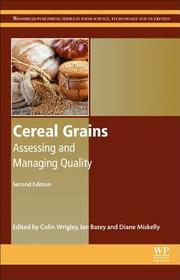
Cereal Grains
Assessing and Managing Quality
Series: Woodhead Publishing Series in Food Science, Technology and Nutrition;
- Publisher's listprice EUR 180.00
-
70 308 Ft (66 960 Ft + 5% VAT)
The price is estimated because at the time of ordering we do not know what conversion rates will apply to HUF / product currency when the book arrives. In case HUF is weaker, the price increases slightly, in case HUF is stronger, the price goes lower slightly.
- Discount 20% (cc. 14 062 Ft off)
- Discounted price 56 246 Ft (53 568 Ft + 5% VAT)
- Discount is valid until: 30 June 2026
Subcribe now and take benefit of a favourable price.
Subscribe
70 308 Ft

Availability
printed on demand
Why don't you give exact delivery time?
Delivery time is estimated on our previous experiences. We give estimations only, because we order from outside Hungary, and the delivery time mainly depends on how quickly the publisher supplies the book. Faster or slower deliveries both happen, but we do our best to supply as quickly as possible.
Product details:
- Edition number 2
- Publisher Elsevier Science
- Date of Publication 12 January 2017
- ISBN 9780081007198
- Binding Hardback
- No. of pages830 pages
- Size 229x152 mm
- Weight 1380 g
- Language English 0
Categories
Long description:
Cereal Grains: Assessing and Managing Quality, Second Edition, provides a timely update to this key reference work. Thoroughly revised from the first edition, this volume examines the latest research and advances in the field. New chapters have been added on alternative grains, including ancient grains and pseudocereals, biosecurity, and industrial processing of grains, amongst others.
Quality and food safety are important throughout the value-addition chain, from breeding, production, harvest, storage, transport, processing, and marketing. At all stages, analysis is needed so that quality management can proceed intelligently. These considerations are examined for each of the major cereal species, including wheat (common and durum), rye and triticale, barley and oats, rice, maize (corn), pseudocereal species, sorghum, and the millets. Divided into five sections, the book analyses these for the range of cereal species before a final section summarizes key findings.
MoreTable of Contents:
Part One: Cereal-grain quality
1. Assessing and managing quality at all stages of the grain chain
2. The cereal grains: providing our food, feed and fuel needs
3. The diversity of uses for cereal grains
4. Cereal-grain morphology and composition
Part Two: Grain-quality characteristics for specific cereals
5. Common wheat: Grain-quality characteristics and management of quality requirements
6. Durum wheat: Grain-quality characteristics and management of quality requirements
7. Rye: Grain-quality characteristics and management of quality requirements
8. Triticale: Grain-quality characteristics and management of quality requirements
9. Barley: Grain-quality characteristics and management of quality requirements
10. Oats: Grain-quality characteristics and management of quality requirements
11. Corn: Grain-quality characteristics and management of quality requirements
12. Rice: Grain-quality characteristics and management of quality requirements
13. Sorghum and millets: Grain-quality characteristics and management of quality requirements
14. Alternative grains: Grain-quality characteristics and management of quality requirements
Part Three: Grain-quality analysis and management
15. Food safety aspects of grain and cereal product quality
16. Breeding for grain-quality traits
17. Identification of grain variety and quality type
18. The effects of growth environment and agronomy on grain quality
19. Analysis of grain quality at receival
20. Grain storage and transport
21. Biosecurity: Safe-guarding quality at all stages of the grain chain
Part Four: Processing cereal grains to optimize product quality
22. Assessing and managing flour quality during and after milling
23. Industrial processing of grains into co-products of protein, starch, oils and fibre
24. Optimisation of end-product quality for the consumer
Part Five: Summary and Appendices
25. Grain quality: the consumer, the scientist, the technologist and the future
Appendix 1: Composition of grains and grain products
Appendix 2: Equivalence between metric, US and Chinese units for the grain industry

