

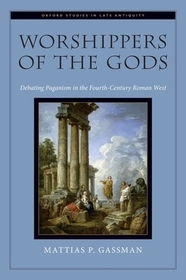
Worshippers of the Gods
Debating Paganism in the Fourth-Century Roman West
Sorozatcím: Oxford Studies in Late Antiquity;
-
20% KEDVEZMÉNY?
- A kedvezmény csak az 'Értesítés a kedvenc témákról' hírlevelünk címzettjeinek rendeléseire érvényes.
- Kiadói listaár GBP 88.00
-
39 732 Ft (37 840 Ft + 5% áfa)
Az ár azért becsült, mert a rendelés pillanatában nem lehet pontosan tudni, hogy a beérkezéskor milyen lesz a forint árfolyama az adott termék eredeti devizájához képest. Ha a forint romlana, kissé többet, ha javulna, kissé kevesebbet kell majd fizetnie.
- Kedvezmény(ek) 20% (cc. 7 946 Ft off)
- Kedvezményes ár 31 786 Ft (30 272 Ft + 5% áfa)
- A kedvezmény érvényes eddig: 2026. június 30.
Iratkozzon fel most és részesüljön kedvezőbb árainkból!
Feliratkozom
39 732 Ft

Beszerezhetőség
Becsült beszerzési idő: A Prosperónál jelenleg nincsen raktáron, de a kiadónál igen. Beszerzés kb. 3-5 hét..
A Prosperónál jelenleg nincsen raktáron.
Why don't you give exact delivery time?
A beszerzés időigényét az eddigi tapasztalatokra alapozva adjuk meg. Azért becsült, mert a terméket külföldről hozzuk be, így a kiadó kiszolgálásának pillanatnyi gyorsaságától is függ. A megadottnál gyorsabb és lassabb szállítás is elképzelhető, de mindent megteszünk, hogy Ön a lehető leghamarabb jusson hozzá a termékhez.
A termék adatai:
- Kiadó OUP USA
- Megjelenés dátuma 2020. július 21.
- ISBN 9780190082444
- Kötéstípus Keménykötés
- Terjedelem252 oldal
- Méret 236x160x25 mm
- Súly 454 g
- Nyelv angol 22
Kategóriák
Rövid leírás:
Worshippers of the Gods shows how fourth-century Latin writers rethought traditional religion during Christianity's rise. Through five interlocking studies of inscriptions, laws, senatorial papers, and Christian polemics, it traces shifting conceptions of paganism from the Tetrarchic persecution, through Constantine's reign, to the 'disestablishment' of the Roman cults in the 380s.
TöbbHosszú leírás:
Worshippers of the Gods tells how the Latin writers who witnessed the political and social rise of Christianity rethought the role of traditional religion in the empire and city of Rome. In parallel with the empire's legal Christianisation, it traces changing attitudes toward paganism from the last empire-wide persecution of Christians under the Tetrarchy to the removal of state funds from the Roman cults in the early 380s. Influential recent scholarship has seen Christian polemical literature-a crucial body of evidence for late antique polytheism-as an exercise in Christian identity-making. In response, Worshippers of the Gods argues that Lactantius, Firmicus Maternus, Ambrosiaster, and Ambrose offered substantive critiques of traditional religion shaped to their political circumstances and to the preoccupations of contemporary polytheists.
By bringing together this polemical literature with imperial laws, pagan inscriptions, and the letters and papers of the senator Symmachus, Worshippers of the Gods reveals the changing horizons of Roman thought on traditional religion in the fourth century. Through its five interlocking case studies, it shows how key episodes in the Empire's religious history-the Tetrarchic persecution, Constantine's adoption of Christianity, the altar of Victory affair, and the 'disestablishment' of the Roman cults-shaped contemporary conceptions of polytheism. It also argues that the idea of a unified 'paganism', often seen as a capricious invention, actually arose as a Christian response to the eclectic, philosophical polytheism in vogue at Rome.
Gassman forcefully and compellingly provides a narrative of the 'polymorphic' discourse on 'traditional Roman Religion' in the fourth century (168). His book is very good, very clear and erudite.... Those who teach or research Christian polemic or apologetic, fourth century paganism, or Roman religious history more broadly will need to reckon with Gassman's book. And those working closely on one of the figures or works he considers closely, such as Lactantius or Symmachus' Relatio 3, will be well served by Gassman's erudite and often unique analysis in the relevant sections.
Tartalomjegyzék:
Acknowledgements
List of abbreviations
Introduction
1. 'Like a Stream of Tullian Eloquence': Lactantius, Cicero, and the Critique of Roman Religion in the Divine Institutes
2. On the Error of Profane Religions: Emperors and Traditional Religion after Constantine
3. 'The Manifold Divinity of the Gods': 'Paganism' in Fourth-Century Rome
4. Rome, Religion, and Christian Emperors: Rethinking the Altar of Victory Affair
5. Commemorating Vettius Agorius Praetextatus: Senators and Traditional Religion in 380s Rome
Conclusion
Bibliography

