

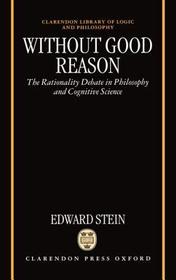
Without Good Reason
The Rationality Debate in Philosophy and Cognitive Science
Sorozatcím: Clarendon Library of Logic and Philosophy;
-
10% KEDVEZMÉNY?
- A kedvezmény csak az 'Értesítés a kedvenc témákról' hírlevelünk címzettjeinek rendeléseire érvényes.
- Kiadói listaár GBP 117.50
-
53 051 Ft (50 525 Ft + 5% áfa)
Az ár azért becsült, mert a rendelés pillanatában nem lehet pontosan tudni, hogy a beérkezéskor milyen lesz a forint árfolyama az adott termék eredeti devizájához képest. Ha a forint romlana, kissé többet, ha javulna, kissé kevesebbet kell majd fizetnie.
- Kedvezmény(ek) 10% (cc. 5 305 Ft off)
- Kedvezményes ár 47 746 Ft (45 473 Ft + 5% áfa)
Iratkozzon fel most és részesüljön kedvezőbb árainkból!
Feliratkozom
53 051 Ft

Beszerezhetőség
Megrendelésre a kiadó utánnyomja a könyvet. Rendelhető, de a szokásosnál kicsit lassabban érkezik meg.
Why don't you give exact delivery time?
A beszerzés időigényét az eddigi tapasztalatokra alapozva adjuk meg. Azért becsült, mert a terméket külföldről hozzuk be, így a kiadó kiszolgálásának pillanatnyi gyorsaságától is függ. A megadottnál gyorsabb és lassabb szállítás is elképzelhető, de mindent megteszünk, hogy Ön a lehető leghamarabb jusson hozzá a termékhez.
A termék adatai:
- Kiadó Clarendon Press
- Megjelenés dátuma 1996. január 11.
- ISBN 9780198235743
- Kötéstípus Keménykötés
- Terjedelem306 oldal
- Méret 224x144x23 mm
- Súly 518 g
- Nyelv angol
- Illusztrációk line figures, tables 0
Kategóriák
Rövid leírás:
Are humans rational? Various experiments performed over the last several decades have been interpreted as showing that humans are irrational; certain philosophers, on the other hand, have argued that it is a conceptual truth that humans must be rational. Without Good Reason offers a clear critical account of the rationality debate in philosophy and cognitive science, concluding that the question of human rationality is indeed an empirical one not a conceptual one.
TöbbHosszú leírás:
Are humans rational? Various experiments performed over the last several decades have been interpreted as showing that humans are irrational--we make significant and consistent errors in logical reasoning, probabilistic reasoning, similarity judgements, and risk-assessment, to name a few areas. But can these experiments establish human irrationality, or is it a conceptual truth that humans must be rational, as various philosophers have argued?
In this book, Edward Stein offers a clear critical account of this debate about rationality in philosophy and cognitive science. He discusses concepts of rationality--the pictures of rationality that the debate centres on--and assesses the empirical evidence used to argue that humans are irrational. He concludes that the question of human rationality must be answered not conceptually but empirically, using the full resources of an advanced cognitive science. Furthermore, he extends this conclusion to argue that empirical considerations are also relevant to the theory of knowledge--in other words, that epistemology should be naturalized.
The whole book is written in a clear, lively and enjoyable style. It is carefully-argued throughout ... it is an excellent attempt at a synoptic cognitivist account of the philosophical implications of the experimental investigation of human rationality. I strongly recommend it to lecturers and students of the philosophy of mind and cognition as the best comprehensive survey of the literature on rationality.

