

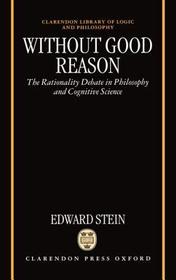
Without Good Reason
The Rationality Debate in Philosophy and Cognitive Science
Series: Clarendon Library of Logic and Philosophy;
- Publisher's listprice GBP 117.50
-
53 051 Ft (50 525 Ft + 5% VAT)
The price is estimated because at the time of ordering we do not know what conversion rates will apply to HUF / product currency when the book arrives. In case HUF is weaker, the price increases slightly, in case HUF is stronger, the price goes lower slightly.
- Discount 10% (cc. 5 305 Ft off)
- Discounted price 47 746 Ft (45 473 Ft + 5% VAT)
Subcribe now and take benefit of a favourable price.
Subscribe
53 051 Ft

Availability
printed on demand
Why don't you give exact delivery time?
Delivery time is estimated on our previous experiences. We give estimations only, because we order from outside Hungary, and the delivery time mainly depends on how quickly the publisher supplies the book. Faster or slower deliveries both happen, but we do our best to supply as quickly as possible.
Product details:
- Publisher Clarendon Press
- Date of Publication 11 January 1996
- ISBN 9780198235743
- Binding Hardback
- No. of pages306 pages
- Size 224x144x23 mm
- Weight 518 g
- Language English
- Illustrations line figures, tables 0
Categories
Short description:
Are humans rational? Various experiments performed over the last several decades have been interpreted as showing that humans are irrational; certain philosophers, on the other hand, have argued that it is a conceptual truth that humans must be rational. Without Good Reason offers a clear critical account of the rationality debate in philosophy and cognitive science, concluding that the question of human rationality is indeed an empirical one not a conceptual one.
MoreLong description:
Are humans rational? Various experiments performed over the last several decades have been interpreted as showing that humans are irrational--we make significant and consistent errors in logical reasoning, probabilistic reasoning, similarity judgements, and risk-assessment, to name a few areas. But can these experiments establish human irrationality, or is it a conceptual truth that humans must be rational, as various philosophers have argued?
In this book, Edward Stein offers a clear critical account of this debate about rationality in philosophy and cognitive science. He discusses concepts of rationality--the pictures of rationality that the debate centres on--and assesses the empirical evidence used to argue that humans are irrational. He concludes that the question of human rationality must be answered not conceptually but empirically, using the full resources of an advanced cognitive science. Furthermore, he extends this conclusion to argue that empirical considerations are also relevant to the theory of knowledge--in other words, that epistemology should be naturalized.
The whole book is written in a clear, lively and enjoyable style. It is carefully-argued throughout ... it is an excellent attempt at a synoptic cognitivist account of the philosophical implications of the experimental investigation of human rationality. I strongly recommend it to lecturers and students of the philosophy of mind and cognition as the best comprehensive survey of the literature on rationality.

