

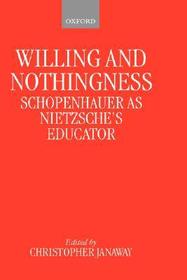
Willing and Nothingness
Schopenhauer as Nietzsche's Educator
-
10% KEDVEZMÉNY?
- A kedvezmény csak az 'Értesítés a kedvenc témákról' hírlevelünk címzettjeinek rendeléseire érvényes.
- Kiadói listaár GBP 155.00
-
69 982 Ft (66 650 Ft + 5% áfa)
Az ár azért becsült, mert a rendelés pillanatában nem lehet pontosan tudni, hogy a beérkezéskor milyen lesz a forint árfolyama az adott termék eredeti devizájához képest. Ha a forint romlana, kissé többet, ha javulna, kissé kevesebbet kell majd fizetnie.
- Kedvezmény(ek) 10% (cc. 6 998 Ft off)
- Kedvezményes ár 62 984 Ft (59 985 Ft + 5% áfa)
Iratkozzon fel most és részesüljön kedvezőbb árainkból!
Feliratkozom
69 982 Ft

Beszerezhetőség
Megrendelésre a kiadó utánnyomja a könyvet. Rendelhető, de a szokásosnál kicsit lassabban érkezik meg.
Why don't you give exact delivery time?
A beszerzés időigényét az eddigi tapasztalatokra alapozva adjuk meg. Azért becsült, mert a terméket külföldről hozzuk be, így a kiadó kiszolgálásának pillanatnyi gyorsaságától is függ. A megadottnál gyorsabb és lassabb szállítás is elképzelhető, de mindent megteszünk, hogy Ön a lehető leghamarabb jusson hozzá a termékhez.
A termék adatai:
- Kiadó OUP Oxford
- Megjelenés dátuma 1998. október 22.
- ISBN 9780198235903
- Kötéstípus Keménykötés
- Terjedelem304 oldal
- Méret 244x164x21 mm
- Súly 593 g
- Nyelv angol 0
Kategóriák
Rövid leírás:
Willing and Nothingness enriches our understanding of Nietzsche's philosophy by examining his relationship with Schopenhauer. Eight leading scholars contribute specially written essays in which Nietzsche's changing conceptions of pessimism, tragedy, art, morality, truth, knowledge, religion, atheism, determinism, the will, and the self are revealed as responses to the work of the thinker he called his `great teacher'.
TöbbHosszú leírás:
Willing and Nothingness illuminates Nietzsche's philosophy by examining his relationship with Schopenhauer. Though Nietzsche was influenced by Schopenhauer's work in his early years, in his later writings he often appears dismissive of Schopenhauer. It is a mistake to take either of these facts at face value: a proper assessment demands an independent understanding of Schopenhauer's philosophy, a close look at Nietzsche's development, and an analysis of the detailed continuities and contrasts with Schopenhauerian themes that permeate his work. This allows not only a reassessment of the connection between these two great thinkers, but a notable enrichment of our understanding of Nietzsche's philosophy, which is too often studied in isolation from its intellectual roots.
With these aims, eight leading scholars contribute specially written essays in which Nietzsche's changing conceptions of pessimism, tragedy, art, morality, truth, knowledge, religion, atheism, determinism, the will, and the self are revealed as responses to the work of the thinker he called his 'great teacher'. These essays are accompanied by a short critical piece that Nietzsche wrote about Schopenhauer in 1868, newly translated and appearing here in English for the first time, and by a guide to all Nietzsche's references to Schopenhauer.
...this book teaches us that there is still much more to discover about Nietzsche...and provides new perspectives on his work.
Tartalomjegyzék:
Introduction
Schopenhauer as Nietzsche's Educator
On Knowledge, Truth, and Value: Nietzsche's Debt to Schopenhauer and the Development of his Empiricism
Schopenhauer and Nietzsche on the Redemption of Life through Art
Nietzsche's Use and Abuse of Schopenhauer's Moral Philosophy for Life
Schopenhauer and Nietzsche: Temperament and Temporality
Schopenhauer and Nietzsche: Honest Atheism, Dishonest Pessimism
Self and Morality in Schopenhauer and Nietzsche
The Paradox of Fatalism and Self-Creation in Nietzsche
Appendix 1: Friedrich Nietzsche `On Schopenhauer'
Appendix 2: Nietzsche's References to Schopenhauer
Notes on the Contributors
Bibliography
Index

