

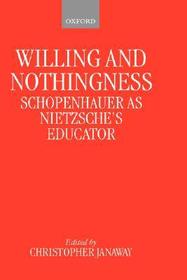
Willing and Nothingness
Schopenhauer as Nietzsche's Educator
- Publisher's listprice GBP 155.00
-
69 982 Ft (66 650 Ft + 5% VAT)
The price is estimated because at the time of ordering we do not know what conversion rates will apply to HUF / product currency when the book arrives. In case HUF is weaker, the price increases slightly, in case HUF is stronger, the price goes lower slightly.
- Discount 10% (cc. 6 998 Ft off)
- Discounted price 62 984 Ft (59 985 Ft + 5% VAT)
Subcribe now and take benefit of a favourable price.
Subscribe
69 982 Ft

Availability
printed on demand
Why don't you give exact delivery time?
Delivery time is estimated on our previous experiences. We give estimations only, because we order from outside Hungary, and the delivery time mainly depends on how quickly the publisher supplies the book. Faster or slower deliveries both happen, but we do our best to supply as quickly as possible.
Product details:
- Publisher OUP Oxford
- Date of Publication 22 October 1998
- ISBN 9780198235903
- Binding Hardback
- No. of pages304 pages
- Size 244x164x21 mm
- Weight 593 g
- Language English 0
Categories
Short description:
Willing and Nothingness enriches our understanding of Nietzsche's philosophy by examining his relationship with Schopenhauer. Eight leading scholars contribute specially written essays in which Nietzsche's changing conceptions of pessimism, tragedy, art, morality, truth, knowledge, religion, atheism, determinism, the will, and the self are revealed as responses to the work of the thinker he called his `great teacher'.
MoreLong description:
Willing and Nothingness illuminates Nietzsche's philosophy by examining his relationship with Schopenhauer. Though Nietzsche was influenced by Schopenhauer's work in his early years, in his later writings he often appears dismissive of Schopenhauer. It is a mistake to take either of these facts at face value: a proper assessment demands an independent understanding of Schopenhauer's philosophy, a close look at Nietzsche's development, and an analysis of the detailed continuities and contrasts with Schopenhauerian themes that permeate his work. This allows not only a reassessment of the connection between these two great thinkers, but a notable enrichment of our understanding of Nietzsche's philosophy, which is too often studied in isolation from its intellectual roots.
With these aims, eight leading scholars contribute specially written essays in which Nietzsche's changing conceptions of pessimism, tragedy, art, morality, truth, knowledge, religion, atheism, determinism, the will, and the self are revealed as responses to the work of the thinker he called his 'great teacher'. These essays are accompanied by a short critical piece that Nietzsche wrote about Schopenhauer in 1868, newly translated and appearing here in English for the first time, and by a guide to all Nietzsche's references to Schopenhauer.
...this book teaches us that there is still much more to discover about Nietzsche...and provides new perspectives on his work.
Table of Contents:
Introduction
Schopenhauer as Nietzsche's Educator
On Knowledge, Truth, and Value: Nietzsche's Debt to Schopenhauer and the Development of his Empiricism
Schopenhauer and Nietzsche on the Redemption of Life through Art
Nietzsche's Use and Abuse of Schopenhauer's Moral Philosophy for Life
Schopenhauer and Nietzsche: Temperament and Temporality
Schopenhauer and Nietzsche: Honest Atheism, Dishonest Pessimism
Self and Morality in Schopenhauer and Nietzsche
The Paradox of Fatalism and Self-Creation in Nietzsche
Appendix 1: Friedrich Nietzsche `On Schopenhauer'
Appendix 2: Nietzsche's References to Schopenhauer
Notes on the Contributors
Bibliography
Index

