

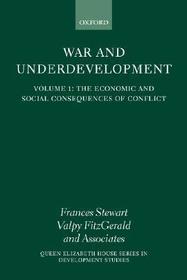
War and Underdevelopment: Volume 1: The Economic and Social Consequences of Conflict
Sorozatcím: Queen Elizabeth House Series in Development Studies;
-
10% KEDVEZMÉNY?
- A kedvezmény csak az 'Értesítés a kedvenc témákról' hírlevelünk címzettjeinek rendeléseire érvényes.
- Kiadói listaár GBP 58.00
-
27 709 Ft (26 390 Ft + 5% áfa)
Az ár azért becsült, mert a rendelés pillanatában nem lehet pontosan tudni, hogy a beérkezéskor milyen lesz a forint árfolyama az adott termék eredeti devizájához képest. Ha a forint romlana, kissé többet, ha javulna, kissé kevesebbet kell majd fizetnie.
- Kedvezmény(ek) 10% (cc. 2 771 Ft off)
- Kedvezményes ár 24 939 Ft (23 751 Ft + 5% áfa)
Iratkozzon fel most és részesüljön kedvezőbb árainkból!
Feliratkozom
27 709 Ft

Beszerezhetőség
Megrendelésre a kiadó utánnyomja a könyvet. Rendelhető, de a szokásosnál kicsit lassabban érkezik meg.
Why don't you give exact delivery time?
A beszerzés időigényét az eddigi tapasztalatokra alapozva adjuk meg. Azért becsült, mert a terméket külföldről hozzuk be, így a kiadó kiszolgálásának pillanatnyi gyorsaságától is függ. A megadottnál gyorsabb és lassabb szállítás is elképzelhető, de mindent megteszünk, hogy Ön a lehető leghamarabb jusson hozzá a termékhez.
A termék adatai:
- Kiadás sorszáma és címe :Volume 1: The Economic and Social Consequences of Conflict
- Kiadó OUP Oxford
- Megjelenés dátuma 2000. november 30.
- ISBN 9780199241873
- Kötéstípus Puhakötés
- Terjedelem280 oldal
- Méret 235x156x14 mm
- Súly 410 g
- Nyelv angol
- Illusztrációk numerous tables and figures 0
Kategóriák
Rövid leírás:
Wars, especially civil wars, are known to be one of the most potent causes of human suffering and underdevelopment. Yet economic analysis of developing countries at war is relatively rare. These volumes aim to reverse this neglect, tracing the economic and social consequences of conflict in poor countries. A major objective is to identify policies which may reduce the heavy human and economic costs. Volume One provides a general framework for understanding the economic interactions. It also provides an empirical overview of the costs of war for the worst affected countries in the 1970s and 1980s. Volume Two presents seven country case studies.
TöbbHosszú leírás:
Wars, especially civil wars, are among the most serious causes of human suffering and underdevelopment. Yet economic analysis of developing countries at war is relatively rare. These volumes aim to reverse this neglect, tracing the economic and social consequences of conflict both theoretically and through empirical investigations, including seven country case studies. A major objective is to identify policies which may reduce the heavy human and economic costs. Volume One provides a general framework for the analysis, examines the political economy of countries at war, and provides an empirical overview of the costs of war for the poor countries worst affected by conflict.
The approach is multidisciplinary: political and sociological analysis is needed in order to understand motivations and behaviour during conflict; while economic analysis is necessary to evaluate how poor people are affected. The analysis includes an investigation of how the international system, including food aid, affects the war economies, and identifies international as well as domestic policies which may reduce the human and economic costs of conflict.
The subject is particularly important in view of the high incidence of wars in poor countries. Between 1950 and 1990, around 15 million deaths were caused (directly or indirectly) by war in developing countries. The end of the Cold War led to a transition to peace in many of the areas in which conflict had been fuelled by East-West antagonism, but new wars erupted. From 1989 to 1995, between 34 and 51 armed conflicts were waged each year, the great majority in poor developing countries.
These volumes investigate economic and social consequences at macro-, meso- and micro- levels, aiming to identify the indirect costs (e.g. via inflation and reduced entitlements) as well as direct costs of military operations. The in-depth country case studies published in Volume Two (Afghanistan, Mozambique, Nicaragua, Sierra Leone, Sri Lanka, Sudan and Uganda) are summarized in Volume One. These explore the main economic mechanisms operating during war and the policy responses of governments and international actors, showing how each can enlarge the costs and further fuel the conflicts. The large variations in this response and in the consequent costs point to domestic and international policies which can reduce the human and economic costs even before peace is restored.
The major contribution of War and Underdevelopment lies in the light that it sheds on the workings of economies during war ... an intellectually challenging read ... There is clearly much to be digested not just by fellow academics but, above all, by development agencies and foreign ministries in donor countries.
Tartalomjegyzék:
Introduction: Assessing the Economic Costs of War
Paying for the War: Economic Policy in Poor Countries
The Political Economy of War
Internal Wars: An Empirical Overview of the Economic and Social Consequences
Overview of Case Studies
The Treatment of Children during Conflict
Food Aid during Civil War: Conflicting Conclusions Derived from Alternative Approaches
Vulnerable Economies and the International Political Economy of Conflict
The Costs of War in Poor Countries: Conclusions and Policy Recommendations

