

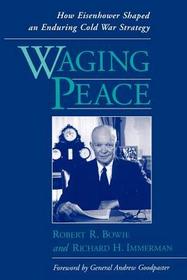
Waging Peace
How Eisenhower Shaped an Enduring Cold War Strategy
-
10% KEDVEZMÉNY?
- A kedvezmény csak az 'Értesítés a kedvenc témákról' hírlevelünk címzettjeinek rendeléseire érvényes.
- Kiadói listaár GBP 43.99
-
19 861 Ft (18 915 Ft + 5% áfa)
Az ár azért becsült, mert a rendelés pillanatában nem lehet pontosan tudni, hogy a beérkezéskor milyen lesz a forint árfolyama az adott termék eredeti devizájához képest. Ha a forint romlana, kissé többet, ha javulna, kissé kevesebbet kell majd fizetnie.
- Kedvezmény(ek) 10% (cc. 1 986 Ft off)
- Kedvezményes ár 17 875 Ft (17 024 Ft + 5% áfa)
Iratkozzon fel most és részesüljön kedvezőbb árainkból!
Feliratkozom
19 861 Ft

Beszerezhetőség
Megrendelésre a kiadó utánnyomja a könyvet. Rendelhető, de a szokásosnál kicsit lassabban érkezik meg.
Why don't you give exact delivery time?
A beszerzés időigényét az eddigi tapasztalatokra alapozva adjuk meg. Azért becsült, mert a terméket külföldről hozzuk be, így a kiadó kiszolgálásának pillanatnyi gyorsaságától is függ. A megadottnál gyorsabb és lassabb szállítás is elképzelhető, de mindent megteszünk, hogy Ön a lehető leghamarabb jusson hozzá a termékhez.
A termék adatai:
- Kiadó OUP USA
- Megjelenés dátuma 2000. október 5.
- ISBN 9780195140484
- Kötéstípus Puhakötés
- Terjedelem426 oldal
- Méret 155x234x21 mm
- Súly 508 g
- Nyelv angol 0
Kategóriák
Rövid leírás:
Waging Peace is a re-examination of President Eisenhower's 'New Look' programme of national security, the foundation for American Cold War policy for the next thirty years. In a turbulent and dangerous stage of East-West relations, with an untested and erratic Soviet leadership and a changing world environment, Eisenhower managed a succession of crises and set a course which ultimately preserved both security and peace. Only now, in the aftermath of the Cold War, can his achievement be fully appreciated.
TöbbHosszú leírás:
Waging Peace offers the first fully comprehensive study of Eisenhower's 'New Look' programme of national security, which provided the groundwork for the next three decades of America's Cold War strategy. Though the Cold War itself and the idea of containment originated under Truman, it was left to Eisenhower to develop the first coherent and sustainable strategy for addressing the issues unique to the nuclear age. To this end, he designated a decision-making system centered around the National Security Council to take full advantage of the expertise and data from various departments and agencies and of the judgment of his principal advisors. The result was the formation of a "long haul" strategy of preventing war and Soviet expansion and of mitigating Soviet hostility. Only now, in the aftermath of the Cold War, can Eisenhower's achievement be fully appreciated.
Waging Peace will be of interest to scholars and students of the Eisenhower era, diplomatic history, the cold war, and contemporary foreign policy.
Bowie and Immerman make an interesting and largely convincing case that the differences between Eisenhower and Truman were more important than the continuities. Their work will become indispensable for our understanding of America's Cold War history.

