

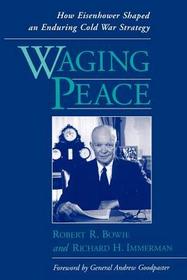
Waging Peace
How Eisenhower Shaped an Enduring Cold War Strategy
- Publisher's listprice GBP 43.99
-
19 861 Ft (18 915 Ft + 5% VAT)
The price is estimated because at the time of ordering we do not know what conversion rates will apply to HUF / product currency when the book arrives. In case HUF is weaker, the price increases slightly, in case HUF is stronger, the price goes lower slightly.
- Discount 10% (cc. 1 986 Ft off)
- Discounted price 17 875 Ft (17 024 Ft + 5% VAT)
Subcribe now and take benefit of a favourable price.
Subscribe
19 861 Ft

Availability
printed on demand
Why don't you give exact delivery time?
Delivery time is estimated on our previous experiences. We give estimations only, because we order from outside Hungary, and the delivery time mainly depends on how quickly the publisher supplies the book. Faster or slower deliveries both happen, but we do our best to supply as quickly as possible.
Product details:
- Publisher OUP USA
- Date of Publication 5 October 2000
- ISBN 9780195140484
- Binding Paperback
- No. of pages426 pages
- Size 155x234x21 mm
- Weight 508 g
- Language English 0
Categories
Short description:
Waging Peace is a re-examination of President Eisenhower's 'New Look' programme of national security, the foundation for American Cold War policy for the next thirty years. In a turbulent and dangerous stage of East-West relations, with an untested and erratic Soviet leadership and a changing world environment, Eisenhower managed a succession of crises and set a course which ultimately preserved both security and peace. Only now, in the aftermath of the Cold War, can his achievement be fully appreciated.
MoreLong description:
Waging Peace offers the first fully comprehensive study of Eisenhower's 'New Look' programme of national security, which provided the groundwork for the next three decades of America's Cold War strategy. Though the Cold War itself and the idea of containment originated under Truman, it was left to Eisenhower to develop the first coherent and sustainable strategy for addressing the issues unique to the nuclear age. To this end, he designated a decision-making system centered around the National Security Council to take full advantage of the expertise and data from various departments and agencies and of the judgment of his principal advisors. The result was the formation of a "long haul" strategy of preventing war and Soviet expansion and of mitigating Soviet hostility. Only now, in the aftermath of the Cold War, can Eisenhower's achievement be fully appreciated.
Waging Peace will be of interest to scholars and students of the Eisenhower era, diplomatic history, the cold war, and contemporary foreign policy.
Bowie and Immerman make an interesting and largely convincing case that the differences between Eisenhower and Truman were more important than the continuities. Their work will become indispensable for our understanding of America's Cold War history.

