

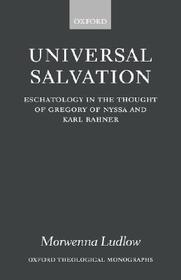
Universal Salvation
Eschatology in the Thought of Gregory of Nyssa and Karl Rahner
Sorozatcím: Oxford Theological Monographs;
-
10% KEDVEZMÉNY?
- A kedvezmény csak az 'Értesítés a kedvenc témákról' hírlevelünk címzettjeinek rendeléseire érvényes.
- Kiadói listaár GBP 240.00
-
108 360 Ft (103 200 Ft + 5% áfa)
Az ár azért becsült, mert a rendelés pillanatában nem lehet pontosan tudni, hogy a beérkezéskor milyen lesz a forint árfolyama az adott termék eredeti devizájához képest. Ha a forint romlana, kissé többet, ha javulna, kissé kevesebbet kell majd fizetnie.
- Kedvezmény(ek) 10% (cc. 10 836 Ft off)
- Kedvezményes ár 97 524 Ft (92 880 Ft + 5% áfa)
Iratkozzon fel most és részesüljön kedvezőbb árainkból!
Feliratkozom
108 360 Ft

Beszerezhetőség
Megrendelésre a kiadó utánnyomja a könyvet. Rendelhető, de a szokásosnál kicsit lassabban érkezik meg.
Why don't you give exact delivery time?
A beszerzés időigényét az eddigi tapasztalatokra alapozva adjuk meg. Azért becsült, mert a terméket külföldről hozzuk be, így a kiadó kiszolgálásának pillanatnyi gyorsaságától is függ. A megadottnál gyorsabb és lassabb szállítás is elképzelhető, de mindent megteszünk, hogy Ön a lehető leghamarabb jusson hozzá a termékhez.
A termék adatai:
- Kiadó OUP Oxford
- Megjelenés dátuma 2000. december 7.
- ISBN 9780198270225
- Kötéstípus Keménykötés
- Terjedelem320 oldal
- Méret 224x146x22 mm
- Súly 496 g
- Nyelv angol 0
Kategóriák
Rövid leírás:
In this book Dr Ludlow compares and assesses two advocates of the belief that in the end God will save all people. It asks whether this idea of 'universal salvation' is a truly Christian concept. If it is a 'second tradition' in Christian theology, how has that tradition developed? What difficulties with the idea still remain?
TöbbHosszú leírás:
For nearly two thousand years Paul's suggestion at the end of 1 Corinthians 15 that God will be 'all in all' has appealed to those who hold a 'wider hope' that eventually no person will be lost from God's love. Clearly, such hope for universal salvation is at variance with most Christian tradition, which has emphasized the possibility, or certainty, of eternal hell. However, a minority of Christian thinkers have advocated the idea and it has provoked much debate in the course of the twentieth century. Responding to this interest, Morwenna Ludlow compares and assesses the arguments for universal salvation by Gregory of Nyssa and Karl Rahner - two influential theologians from very different eras who are less well known for their eschatological views.
In this book Dr Ludlow gives an assessment of early Christian eschatology and its effect on modern theology by examining some fundamental questions. Does universal salvation constitute a 'second tradition' of eschatology and how has that tradition developed? What can we learn from Patristic writers such as Gregory of Nyssa? How does one approach Christian eschatology in a modern context?
Well-written and balanced

