

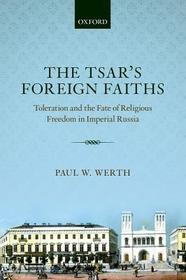
The Tsar's Foreign Faiths
Toleration and the Fate of Religious Freedom in Imperial Russia
Sorozatcím: Oxford Studies in Modern European History;
-
10% KEDVEZMÉNY?
- A kedvezmény csak az 'Értesítés a kedvenc témákról' hírlevelünk címzettjeinek rendeléseire érvényes.
- Kiadói listaár GBP 41.49
-
18 732 Ft (17 840 Ft + 5% áfa)
Az ár azért becsült, mert a rendelés pillanatában nem lehet pontosan tudni, hogy a beérkezéskor milyen lesz a forint árfolyama az adott termék eredeti devizájához képest. Ha a forint romlana, kissé többet, ha javulna, kissé kevesebbet kell majd fizetnie.
- Kedvezmény(ek) 10% (cc. 1 873 Ft off)
- Kedvezményes ár 16 859 Ft (16 056 Ft + 5% áfa)
Iratkozzon fel most és részesüljön kedvezőbb árainkból!
Feliratkozom
18 732 Ft

Beszerezhetőség
Megrendelésre a kiadó utánnyomja a könyvet. Rendelhető, de a szokásosnál kicsit lassabban érkezik meg.
Why don't you give exact delivery time?
A beszerzés időigényét az eddigi tapasztalatokra alapozva adjuk meg. Azért becsült, mert a terméket külföldről hozzuk be, így a kiadó kiszolgálásának pillanatnyi gyorsaságától is függ. A megadottnál gyorsabb és lassabb szállítás is elképzelhető, de mindent megteszünk, hogy Ön a lehető leghamarabb jusson hozzá a termékhez.
A termék adatai:
- Kiadó OUP Oxford
- Megjelenés dátuma 2016. április 28.
- ISBN 9780198786610
- Kötéstípus Puhakötés
- Terjedelem304 oldal
- Méret 234x156x16 mm
- Súly 434 g
- Nyelv angol
- Illusztrációk 5 black and white maps 0
Kategóriák
Rövid leírás:
Explores the scope and character of religious freedom for Russia's diverse non-Orthodox religions during the tzarist regime.
TöbbHosszú leírás:
The Russian Empire presented itself to its subjects and the world as an Orthodox state, a patron and defender of Eastern Christianity. Yet the tsarist regime also lauded itself for granting religious freedoms to its many heterodox subjects, making 'religious toleration' a core attribute of the state's identity. The Tsar's Foreign Faiths shows that the resulting tensions between the autocracy's commitments to Orthodoxy and its claims to toleration became a defining feature of the empire's religious order.
In this panoramic account, Paul W. Werth explores the scope and character of religious freedom for Russia's diverse non-Orthodox religions, from Lutheranism and Catholicism to Islam and Buddhism. Considering both rhetoric and practice, he examines discourses of religious toleration and the role of confessional institutions in the empire's governance. He reveals the paradoxical status of Russia's heterodox faiths as both established and 'foreign', and explains the dynamics that shaped the fate of newer conceptions of religious liberty after the mid-nineteenth century. If intellectual change and the shifting character of religious life in Russia gradually pushed the regime towards the acceptance of freedom of conscience, then statesmen's nationalist sentiments and their fears of 'politicized' religion impeded this development. Russia's religious order thus remained beset by contradiction on the eve of the Great War. Based on archival research in five countries and a vast scholarly literature, The Tsar's Foreign Faiths represents a major contribution to the history of empire and religion in Russia, and to the study of toleration and religious diversity in Europe.
Those teaching the history of Imperial Russia at university level would be well served by adding this work to their syllabus. Far from being a straightforward history of religion, Werth offers up a highly stimulating study that reveals a great deal about the Russian state's broad attitude towards toleration and freedom of conscience. More generally, anyone interested in the complex practices of imperial rule in Russia, beset as it was by tensions and contradictions, will gain many insights by reading The Tsar's Foreign Faiths.
Tartalomjegyzék:
Introduction
Early-Modern Bequests
The Multiconfessional Establishment
Matters of Integrity
The Rhetoric and Content of 'Religious Toleration'
Prospects of Reform
Depoliticizing Piety, Russifying Faith
Towards Expanded Religious Freedom
Freedom of Conscience as Legislative Project
The Foreign Confessions in the Empire's Twilight
Conclusion: Between Toleration and Freedom of Conscience

