

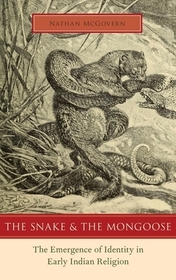
The Snake and the Mongoose
The Emergence of Identity in Early Indian Religion
-
10% KEDVEZMÉNY?
- A kedvezmény csak az 'Értesítés a kedvenc témákról' hírlevelünk címzettjeinek rendeléseire érvényes.
- Kiadói listaár GBP 96.00
-
43 344 Ft (41 280 Ft + 5% áfa)
Az ár azért becsült, mert a rendelés pillanatában nem lehet pontosan tudni, hogy a beérkezéskor milyen lesz a forint árfolyama az adott termék eredeti devizájához képest. Ha a forint romlana, kissé többet, ha javulna, kissé kevesebbet kell majd fizetnie.
- Kedvezmény(ek) 10% (cc. 4 334 Ft off)
- Kedvezményes ár 39 010 Ft (37 152 Ft + 5% áfa)
Iratkozzon fel most és részesüljön kedvezőbb árainkból!
Feliratkozom
43 344 Ft

Beszerezhetőség
Megrendelésre a kiadó utánnyomja a könyvet. Rendelhető, de a szokásosnál kicsit lassabban érkezik meg.
Why don't you give exact delivery time?
A beszerzés időigényét az eddigi tapasztalatokra alapozva adjuk meg. Azért becsült, mert a terméket külföldről hozzuk be, így a kiadó kiszolgálásának pillanatnyi gyorsaságától is függ. A megadottnál gyorsabb és lassabb szállítás is elképzelhető, de mindent megteszünk, hogy Ön a lehető leghamarabb jusson hozzá a termékhez.
A termék adatai:
- Kiadó OUP USA
- Megjelenés dátuma 2019. január 3.
- ISBN 9780190640798
- Kötéstípus Keménykötés
- Terjedelem328 oldal
- Méret 236x157x33 mm
- Súly 567 g
- Nyelv angol 0
Kategóriák
Rövid leírás:
In The Snake and The Mongoose, Nathan McGovern turns the commonly-accepted model of the origins of early Indian religions on its head. Instead of assuming a fundamental dichotomy between Brahmanical and non-Brahmanical in ancient India, McGovern shows that there were many different groups who all saw themselves as Brahmanical, and out of whose contestation with one another the distinction between Brahmanical and non-Brahmanical emerged.
TöbbHosszú leírás:
Since the beginning of modern Indology in the 19th century, the relationship between the early Indian religions of Buddhism, Jainism, and Hinduism has been predicated on a perceived dichotomy between two meta-historical identities: "the Brahmans" (purveyors of the ancient Vedic texts and associated ritual system) and the newer "non-Brahmanical" sramana movements from which the Buddhists and Jains emerged. Textbook and scholarly accounts postulate an opposition between these two groups, citing the 2nd-century BCE Sanskrit grammarian Patañjali, who is often quoted erroneously as likening them to the proverbial enemies snake and mongoose. Scholars continue to privilege Brahmanical Hindu accounts of early Indian history, and further portray Buddhist and Jain deviations from those accounts as evidence of their opposition to a pre-existing Brahmanism.
In The Snake and The Mongoose, Nathan McGovern turns this commonly-accepted model of the origins of the early Indian religions on its head. His book seeks to de-center the Hindu Brahman from our understanding of Indian religion by "taming the snake and the mongoose"--that is, by abandoning the anachronistic distinction between "Brahmanical" and "non-Brahmanical." Instead, McGovern allows the earliest articulations of identity in Indian religion to speak for themselves through a comparative reading of texts preserved by the three major groups that emerged from the social, political, cultural, and religious foment of the late first millennium BCE: the Buddhists and Jains as they represented themselves in their earliest sutras, and the Vedic Brahmans as they represented themselves in their Dharma Sutras. The picture that emerges is not of a fundamental dichotomy between Brahmanical and non-Brahmanical, but rather of many different groups who all saw themselves as Brahmanical. Thus, McGovern argues, it was through the contestation between these groups that the distinction between Brahmanical and non-Brahmanical--the snake and the mongoose--emerged.
This monograph reflects the cyclical scholarly interest in the overlapping chronological and sectarian boundaries of Indian Buddhism...The chapters are well-organized and present philological analytic work in an unintimidating fashion, though will still likely appeal more to graduate students and scholars than undergraduate students.
Tartalomjegyzék:
Acknowledgements
Abbreviations
1. Introduction
2. The Snake and the Mongoose at the Horizon of Indian History
3. Taming the Snake and the Mongoose of Indian History
4. The Brahman as a Celibate Renunciant
5. The Brahman as a Head of a Household
6. The Emergence of the Snake and the Mongoose
7. Losing an Argument by Focusing on Being Right
8. Conclusion
Bibliography

