

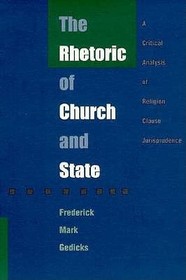
The Rhetoric of Church and State
A Critical Analysis of Religion Clause Jurisprudence
-
10% KEDVEZMÉNY?
- A kedvezmény csak az 'Értesítés a kedvenc témákról' hírlevelünk címzettjeinek rendeléseire érvényes.
- Kiadói listaár GBP 23.99
-
11 461 Ft (10 915 Ft + 5% áfa)
Az ár azért becsült, mert a rendelés pillanatában nem lehet pontosan tudni, hogy a beérkezéskor milyen lesz a forint árfolyama az adott termék eredeti devizájához képest. Ha a forint romlana, kissé többet, ha javulna, kissé kevesebbet kell majd fizetnie.
- Kedvezmény(ek) 10% (cc. 1 146 Ft off)
- Kedvezményes ár 10 315 Ft (9 824 Ft + 5% áfa)
Kedvezményes ár heti hírlevelünkre feliratkozott ügyfeleinknek.
Iratkozzon fel most és részesüljön kedvezőbb árainkból!
Feliratkozom
Iratkozzon fel most és részesüljön kedvezőbb árainkból!
Feliratkozom
11 461 Ft

Beszerezhetőség
A kiadónál átmenetileg nincs raktáron, ezért a szokásosnál (2-4 hét) többet kell várni a beszerzésre. Ez általában néhány hét plusz időt jelent.
Why don't you give exact delivery time?
A beszerzés időigényét az eddigi tapasztalatokra alapozva adjuk meg. Azért becsült, mert a terméket külföldről hozzuk be, így a kiadó kiszolgálásának pillanatnyi gyorsaságától is függ. A megadottnál gyorsabb és lassabb szállítás is elképzelhető, de mindent megteszünk, hogy Ön a lehető leghamarabb jusson hozzá a termékhez.
A termék adatai:
- Kiadó Duke University Press
- Megjelenés dátuma 1995. október 17.
- Kötetek száma Trade Paperback
- ISBN 9780822316664
- Kötéstípus Puhakötés
- Terjedelem184 oldal
- Méret 250x150x15 mm
- Súly 363 g
- Nyelv angol 0
Kategóriák
Hosszú leírás:
During the middle of the twentieth century, the religiously informed communitarianism that had guided the Supreme Court’s decisions regarding the relationship between church and state was partially displaced by a new secular individualist discourse. In The Rhetoric of Church and State, Frederick Mark Gedicks argues that this partial and incomplete shift is the key to understanding why the Court has failed-and continues today to fail-to provide a coherent doctrine on church/state separation.
Gedicks suggests that the Supreme Court’s inconsistent decisions mirror a divergence in American society between an increasingly secular public culture and the primarily devout private lives of the majority of Americans. He notes that while the Court is committed to principles of secular individualism, it has repeatedly endorsed government actions that violate those principles-actions that would be far more justifiable under the discourse of religious communitarianism. The impossibility of reconciling the two discourses leaves the Court no choice but to efface-often implausibly-the religious nature of practices it deems permissible. Gedicks concludes that the road to a coherent religion clause doctrine lies neither in a return to religious communitarianism nor in its complete displacement by secular individualism, but in a yet-to-be-identified discourse that would attract popular support while protecting a meaningful measure of religious freedom.
Több
Gedicks suggests that the Supreme Court’s inconsistent decisions mirror a divergence in American society between an increasingly secular public culture and the primarily devout private lives of the majority of Americans. He notes that while the Court is committed to principles of secular individualism, it has repeatedly endorsed government actions that violate those principles-actions that would be far more justifiable under the discourse of religious communitarianism. The impossibility of reconciling the two discourses leaves the Court no choice but to efface-often implausibly-the religious nature of practices it deems permissible. Gedicks concludes that the road to a coherent religion clause doctrine lies neither in a return to religious communitarianism nor in its complete displacement by secular individualism, but in a yet-to-be-identified discourse that would attract popular support while protecting a meaningful measure of religious freedom.

