

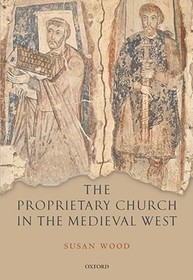
The Proprietary Church in the Medieval West
-
10% KEDVEZMÉNY?
- A kedvezmény csak az 'Értesítés a kedvenc témákról' hírlevelünk címzettjeinek rendeléseire érvényes.
- Kiadói listaár GBP 305.00
-
145 713 Ft (138 775 Ft + 5% áfa)
Az ár azért becsült, mert a rendelés pillanatában nem lehet pontosan tudni, hogy a beérkezéskor milyen lesz a forint árfolyama az adott termék eredeti devizájához képest. Ha a forint romlana, kissé többet, ha javulna, kissé kevesebbet kell majd fizetnie.
- Kedvezmény(ek) 10% (cc. 14 571 Ft off)
- Kedvezményes ár 131 142 Ft (124 898 Ft + 5% áfa)
Iratkozzon fel most és részesüljön kedvezőbb árainkból!
Feliratkozom
145 713 Ft

Beszerezhetőség
Megrendelésre a kiadó utánnyomja a könyvet. Rendelhető, de a szokásosnál kicsit lassabban érkezik meg.
Why don't you give exact delivery time?
A beszerzés időigényét az eddigi tapasztalatokra alapozva adjuk meg. Azért becsült, mert a terméket külföldről hozzuk be, így a kiadó kiszolgálásának pillanatnyi gyorsaságától is függ. A megadottnál gyorsabb és lassabb szállítás is elképzelhető, de mindent megteszünk, hogy Ön a lehető leghamarabb jusson hozzá a termékhez.
A termék adatai:
- Kiadó OUP Oxford
- Megjelenés dátuma 2006. augusztus 3.
- ISBN 9780198206972
- Kötéstípus Keménykötés
- Terjedelem1020 oldal
- Méret 253x175x60 mm
- Súly 1938 g
- Nyelv angol
- Illusztrációk map 0
Kategóriák
Rövid leírás:
This book examines in what ways and how far medieval churches were treated as items of property. It ranges over most of Western Europe, from beginnings in the late Roman Empire and post-Roman kingdoms, into the Carolingian empire and its neighbours and successor states; and through the Gregorian reform, up to the late twelfth century when property in churches was patchily superseded by the canon-law right of patronage. The approach is as much social and religious as legal and administrative, and explores ideas and assumptions as well as practical exploitation and property dealings.
TöbbHosszú leírás:
Although there have been many regional studies of the proprietary church or particular aspects of it, this is the first extensive study of it covering most of western Europe, from the end of the Roman Empire in the West to about 1200. The book aims at a broad survey in varying degrees of intensity and with a shifting geographical focus; and it asks questions that are as much social and religious as legal or administrative.
The book vindicates, for village and estate churches, Ulrich Stutz's basic concept of a church with its possessions, revenues, and priestly office as an object of what we can reasonably call property. But it largely rejects his and his followers' application of this to great churches, and sees the position of intermediate churches (such as small or middling monasteries) as various, changeable, and ambivalent. Above all it turns away from Stutz's view of the property relationship as a distinct institution or system of 'Germanic church law', presenting it rather as a fluid set of assumptions and practices taking shape as customary law.
The book considers also the changing background of ideas and the bearing on it of important polemical writings (with some questioning of their established interpretations). Finally the book discusses how property in churches was imperfectly superseded by the new canon-law patronage, in the increasingly bureaucratic post-Gregorian Church.
Wood's impressive study of the propriety church, a study which should enrich current debates, leaven further research, and assume its place as a momument of contemorary medieval scholarship.
Tartalomjegyzék:
Part I: Beginnings
The Roman Empire and Post-Roman Kingdoms
A New Stage: Bavaria, Alemania, and Lombard Italy, Mid-Eighth to Mid-Ninth Century
The Converging of Private and Parish Churches
The Question of Origins
Early Monasteries: Their Founders and Abbotts
Some Non-Frankish Patterns of Family Interest in Monasteries
Transition to Outside Lordship of Monasteries
The Emergence of Bishop's Lordship over Monasteries
The Emergence of Lay Ruler's Lordship over Monasteries
Part II: Lordship over Higher Churches, Ninth to Eleventh Centuries
Kings and Princes
Nobles other than Founder's Heirs
Noble Founders and their Heirs
Great Churches as Lords of Monasteries
Part III: Lower Churches as Property, Ninth to Eleventh Centuries
Lesser Churches' Resources in Lands and other Possessions
Lesser Churches' Resources in Tithes and Offerings
Proprietors' Arrangements with their Priests
Lay Proprietors
Priests as Proprietors
Higher Churches as Proprietors
Some Proprietary Elements in a Bishop's Authority
Part IV: Ideas, Opinion, Change
The Juridical Condition of Churches
Legislation and Reforming Opinion
Monastic Reform: Lordship and Liberty
Gregorian Reform
Towards a Bureaucratic Church
The Longer Term
Bibliography
Index

