

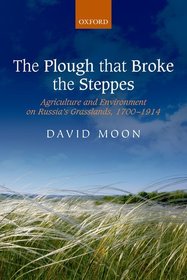
The Plough that Broke the Steppes
Agriculture and Environment on Russia's Grasslands, 1700-1914
Sorozatcím: Oxford Studies in Modern European History;
-
10% KEDVEZMÉNY?
- A kedvezmény csak az 'Értesítés a kedvenc témákról' hírlevelünk címzettjeinek rendeléseire érvényes.
- Kiadói listaár GBP 52.00
-
23 478 Ft (22 360 Ft + 5% áfa)
Az ár azért becsült, mert a rendelés pillanatában nem lehet pontosan tudni, hogy a beérkezéskor milyen lesz a forint árfolyama az adott termék eredeti devizájához képest. Ha a forint romlana, kissé többet, ha javulna, kissé kevesebbet kell majd fizetnie.
- Kedvezmény(ek) 10% (cc. 2 348 Ft off)
- Kedvezményes ár 21 130 Ft (20 124 Ft + 5% áfa)
Iratkozzon fel most és részesüljön kedvezőbb árainkból!
Feliratkozom
23 478 Ft

Beszerezhetőség
Megrendelésre a kiadó utánnyomja a könyvet. Rendelhető, de a szokásosnál kicsit lassabban érkezik meg.
Why don't you give exact delivery time?
A beszerzés időigényét az eddigi tapasztalatokra alapozva adjuk meg. Azért becsült, mert a terméket külföldről hozzuk be, így a kiadó kiszolgálásának pillanatnyi gyorsaságától is függ. A megadottnál gyorsabb és lassabb szállítás is elképzelhető, de mindent megteszünk, hogy Ön a lehető leghamarabb jusson hozzá a termékhez.
A termék adatai:
- Kiadó OUP Oxford
- Megjelenés dátuma 2014. október 9.
- ISBN 9780198722878
- Kötéstípus Puhakötés
- Terjedelem340 oldal
- Méret 235x157x20 mm
- Súly 482 g
- Nyelv angol
- Illusztrációk Four maps and 3 black and white images 0
Kategóriák
Rövid leírás:
This is the first environmental history of Russia's steppes. David Moon focuses on the settlement of migrants from central Russia, Ukraine, and central Europe, and analyses how naturalists and scientists came to understand the steppe environment, including the origins of the fertile black earth.
TöbbHosszú leírás:
This is the first environmental history of Russia's steppes. From the early-eighteenth century, settlers moved to the semi-arid but fertile grasslands from wetter, forested regions in central and northern Russia and Ukraine, and from central Europe. By the late-nineteenth century, they had turned the steppes into the bread basket of the Russian Empire and parts of Europe. But there was another side to this story. The steppe region was hit by recurring droughts, winds from the east whipped up dust storms, the fertile black earth suffered severe erosion, crops failed, and in the worst years there was famine.
David Moon analyses how naturalists and scientists came to understand the steppe environment, including the origins of the fertile black earth. He also analyses how scientists tried to understand environmental change, including climate change. Farmers, and the scientists who advised them, tried different ways to deal with the recurring droughts: planting trees, irrigation, and cultivating the soil. More sustainable, however, were techniques of cultivation to retain scarce moisture in the soil. Among the pioneers were Mennonite settlers. Such approaches aimed to work with the environment, rather than trying to change it by planting trees or supplying more water artificially.
The story is similar to the Dust Bowl on the Great Plains of the USA, which share a similar environment and environmental history. David Moon places the story of the steppes in the wider context of the environmental history of European colonialism around the globe.
Rare is the book that casts Russian history in an almost wholly new light.
Tartalomjegyzék:
Introduction
Part I: Understanding the Steppe Environment
The Eyes of Outsiders
The Lens of Science and Statistics
Part II: Understanding Environmental Change
Introduction: Who is to Blame?
Vegetation
Climate Change
The Land
Part III: Combating the Steppe Environment?
Introduction: What is to be Done?
Tree Planting
Irrigation
Agronomy
Conclusion
Epilogue

