

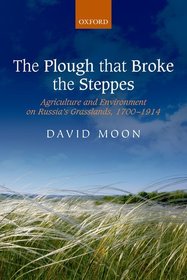
The Plough that Broke the Steppes
Agriculture and Environment on Russia's Grasslands, 1700-1914
Series: Oxford Studies in Modern European History;
- Publisher's listprice GBP 52.00
-
23 478 Ft (22 360 Ft + 5% VAT)
The price is estimated because at the time of ordering we do not know what conversion rates will apply to HUF / product currency when the book arrives. In case HUF is weaker, the price increases slightly, in case HUF is stronger, the price goes lower slightly.
- Discount 10% (cc. 2 348 Ft off)
- Discounted price 21 130 Ft (20 124 Ft + 5% VAT)
Subcribe now and take benefit of a favourable price.
Subscribe
23 478 Ft

Availability
printed on demand
Why don't you give exact delivery time?
Delivery time is estimated on our previous experiences. We give estimations only, because we order from outside Hungary, and the delivery time mainly depends on how quickly the publisher supplies the book. Faster or slower deliveries both happen, but we do our best to supply as quickly as possible.
Product details:
- Publisher OUP Oxford
- Date of Publication 9 October 2014
- ISBN 9780198722878
- Binding Paperback
- No. of pages340 pages
- Size 235x157x20 mm
- Weight 482 g
- Language English
- Illustrations Four maps and 3 black and white images 0
Categories
Short description:
This is the first environmental history of Russia's steppes. David Moon focuses on the settlement of migrants from central Russia, Ukraine, and central Europe, and analyses how naturalists and scientists came to understand the steppe environment, including the origins of the fertile black earth.
MoreLong description:
This is the first environmental history of Russia's steppes. From the early-eighteenth century, settlers moved to the semi-arid but fertile grasslands from wetter, forested regions in central and northern Russia and Ukraine, and from central Europe. By the late-nineteenth century, they had turned the steppes into the bread basket of the Russian Empire and parts of Europe. But there was another side to this story. The steppe region was hit by recurring droughts, winds from the east whipped up dust storms, the fertile black earth suffered severe erosion, crops failed, and in the worst years there was famine.
David Moon analyses how naturalists and scientists came to understand the steppe environment, including the origins of the fertile black earth. He also analyses how scientists tried to understand environmental change, including climate change. Farmers, and the scientists who advised them, tried different ways to deal with the recurring droughts: planting trees, irrigation, and cultivating the soil. More sustainable, however, were techniques of cultivation to retain scarce moisture in the soil. Among the pioneers were Mennonite settlers. Such approaches aimed to work with the environment, rather than trying to change it by planting trees or supplying more water artificially.
The story is similar to the Dust Bowl on the Great Plains of the USA, which share a similar environment and environmental history. David Moon places the story of the steppes in the wider context of the environmental history of European colonialism around the globe.
Rare is the book that casts Russian history in an almost wholly new light.
Table of Contents:
Introduction
Part I: Understanding the Steppe Environment
The Eyes of Outsiders
The Lens of Science and Statistics
Part II: Understanding Environmental Change
Introduction: Who is to Blame?
Vegetation
Climate Change
The Land
Part III: Combating the Steppe Environment?
Introduction: What is to be Done?
Tree Planting
Irrigation
Agronomy
Conclusion
Epilogue

