

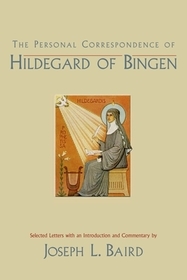
The Personal Correspondence of Hildegard of Bingen
Sorozatcím: Letters of Hildegard of Bingen;
-
10% KEDVEZMÉNY?
- A kedvezmény csak az 'Értesítés a kedvenc témákról' hírlevelünk címzettjeinek rendeléseire érvényes.
- Kiadói listaár GBP 41.99
-
20 060 Ft (19 105 Ft + 5% áfa)
Az ár azért becsült, mert a rendelés pillanatában nem lehet pontosan tudni, hogy a beérkezéskor milyen lesz a forint árfolyama az adott termék eredeti devizájához képest. Ha a forint romlana, kissé többet, ha javulna, kissé kevesebbet kell majd fizetnie.
- Kedvezmény(ek) 10% (cc. 2 006 Ft off)
- Kedvezményes ár 18 054 Ft (17 195 Ft + 5% áfa)
Iratkozzon fel most és részesüljön kedvezőbb árainkból!
Feliratkozom
20 060 Ft

Beszerezhetőség
Megrendelésre a kiadó utánnyomja a könyvet. Rendelhető, de a szokásosnál kicsit lassabban érkezik meg.
Why don't you give exact delivery time?
A beszerzés időigényét az eddigi tapasztalatokra alapozva adjuk meg. Azért becsült, mert a terméket külföldről hozzuk be, így a kiadó kiszolgálásának pillanatnyi gyorsaságától is függ. A megadottnál gyorsabb és lassabb szállítás is elképzelhető, de mindent megteszünk, hogy Ön a lehető leghamarabb jusson hozzá a termékhez.
A termék adatai:
- Kiadó OUP USA
- Megjelenés dátuma 2006. szeptember 28.
- ISBN 9780195308235
- Kötéstípus Puhakötés
- Terjedelem208 oldal
- Méret 211x140x15 mm
- Súly 263 g
- Nyelv angol 0
Kategóriák
Rövid leírás:
Illuminates the personal life of Hildegard of Bingen as viewed through the defining lens of her personal correspondence: her early, hesitant bid for recognition of her spiritual gifts; her courageous, and ultimately futile, fight to retain the companionship of her close personal friend and the poignant outcome of that struggle; and more.
TöbbHosszú leírás:
Hildegard of Bingen (1098-1179) was one of the most remarkable women of her day. From early childhood she experienced religious visions, and at the age of eight she entered a cloistered religious life in the Benedictine monastery of Disibondenberg. Eventually she not only became abbess of the community, but presided over the establishment of an important new convent near Bingen. All but forgotten for hundreds of years, Hildegard was rediscovered in the 1980s and since then her visionary writings have been widely read and studied. Even more surprisingly, music that she composed has been performed and recorded to great acclaim. She has come to be seen by some as a proto-feminist icon -- a woman of great accomplishments who made her own way in a man's world and exerted extraordinary influence over some of the most powerful figures of her time. Much of Hildegard's correspondence has been preserved. It reveals that for more than 30 years this cloistered nun was an unflinching adviser and correspondent to all levels of church and society, from popes and kings to ordinary lay persons, from Jerusalem to England. With the 2004 OUP publication of Volume III of Joseph Baird and Radd Ehrman's translation, the complete correspondence became available for the first time in English. For this new abridgement, Baird has selected 75 of the most interesting and revealing of the letters from Volumes I, II, and III. Freed from the organizational restraints of the Latin edition of the letters, he has arranged them in roughly chronological order and provided greatly expanded, accessibly written introductory notes that contextualize the letters and explain their significance. As a result, this fascinating collection serves as a kind of life in letters that makes an ideal introduction ot this exceptional woman, her world, and her work. This book is the first to give a thorough and definitive illlumination of the personal life of Hildegard of Bingen as viewed through the defining lens of her personal correspondence: her early, hesitant bid for recognition of her spiritual gifts; her courageous, and ultimately futile, fight to retain the companionship of her close personal friend and the poignant outcome of that struggle; her vehement defiance of the male hierarchy in her bid to establish her own communities under her personal governance; her impudent challenge to contemporary conservatives views by the dress and customs she established in her community; her paean of praise for the power of music; and her adamant refusal, even at the advanced age of eighty, to give in to the demands of the male authorities even in the face of excommunication.
[an] accessible [and] illuminating collection of her writings...set within an unobtrusive but skilfully crafted mini-biography of the saint.

