

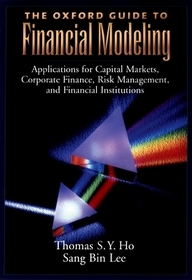
The Oxford Guide to Financial Modeling
Applications for Capital Markets, Corporate Finance, Risk Management and Financial Institutions
-
10% KEDVEZMÉNY?
- A kedvezmény csak az 'Értesítés a kedvenc témákról' hírlevelünk címzettjeinek rendeléseire érvényes.
- Kiadói listaár GBP 202.50
-
91 428 Ft (87 075 Ft + 5% áfa)
Az ár azért becsült, mert a rendelés pillanatában nem lehet pontosan tudni, hogy a beérkezéskor milyen lesz a forint árfolyama az adott termék eredeti devizájához képest. Ha a forint romlana, kissé többet, ha javulna, kissé kevesebbet kell majd fizetnie.
- Kedvezmény(ek) 10% (cc. 9 143 Ft off)
- Kedvezményes ár 82 286 Ft (78 368 Ft + 5% áfa)
Iratkozzon fel most és részesüljön kedvezőbb árainkból!
Feliratkozom
91 428 Ft

Beszerezhetőség
Megrendelésre a kiadó utánnyomja a könyvet. Rendelhető, de a szokásosnál kicsit lassabban érkezik meg.
Why don't you give exact delivery time?
A beszerzés időigényét az eddigi tapasztalatokra alapozva adjuk meg. Azért becsült, mert a terméket külföldről hozzuk be, így a kiadó kiszolgálásának pillanatnyi gyorsaságától is függ. A megadottnál gyorsabb és lassabb szállítás is elképzelhető, de mindent megteszünk, hogy Ön a lehető leghamarabb jusson hozzá a termékhez.
A termék adatai:
- Kiadó OUP USA
- Megjelenés dátuma 2004. február 12.
- ISBN 9780195169621
- Kötéstípus Keménykötés
- Terjedelem768 oldal
- Méret 185x257x43 mm
- Súly 1539 g
- Nyelv angol
- Illusztrációk numerous line figures 0
Kategóriák
Rövid leírás:
The book discusses the theory and applications of more than 122 financial models currently in use and includes the financial models of stock and bond options, exotic options, investment grade and high-yield bonds, convertible bonds, mortgage-backed securities, liabilities of financial institutions' business models and corporate models.
TöbbHosszú leírás:
The essential premise of this book is that theory and practice are equally important in describing financial modeling. In it the authors try to strike a balance in their discussions between theories that provide foundations for financial models and the institutional details that provide the context for applications of the models. The book presents the financial models of stock and bond options, exotic options, investment grade and high-yield bonds, convertible bonds, mortgage-backed securities, liabilities of financial institutions -- the business model and the corporate model. It also describes the applications of the models to corporate finance. Furthermore, it relates the models to financial statements, risk management for an enterprise, and asset/liability management with illiquid instruments. The financial models are progressively presented from option pricing in the securities markets to firm valuation in corporate finance, following a format to emphasize the three aspects of a model: the set of assumptions, the model specification, and the model applications. Generally, financial modeling books segment the world of finance as "investments," "financial institutions," "corporate finance," and "securities analysis," and in so doing they rarely emphasize the relationships between the subjects. This unique book successfully ties the thought processes and applications of the financial models together and describes them as one process that provides business solutions. Created as a companion website to the book readers can visit www.thomasho.com to gain deeper understanding of the book's financial models. Interested readers can build and test the models described in the book using Excel, and they can submit their models to the site. Readers can also use the site's forum to discuss the models and can browse server based models to gain insights into the applications of the models. For those using the book in meetings or class settings the site provides Power Point descriptions of the chapters. Students can use available question banks on the chapters for studying.
"This book showcases Dr. Ho's tireless journey into the frontier of finance over the years. It clearly demonstrates how various rigorous financial models can be practically incorporated into companies' strategic decision making and enterprise risk management. The book challenges our conventional thinking in capital structure theory, interest rate behavior and default risk pricing. It should provoke debate for many years to come." --Tony Kao, Managing Director, Global Fixed Income, General Motors Asset Management
Tartalomjegyzék:
PART 1. DERIVATIVES VALUATION
Introduction: Discounted Cash Flow Method
Equity Market: the Capital Asset Pricing Model
Bond Markets: the Bond Model
Equity Options: the Black-Scholes Model
Interest Rate Derivatives: Interest Rate Models
Implied Volatility Surface: Calibrating the Models
Exotic Options: Bellman's Optimization, Filtration Model and n-Factor Model
PART 2. CORPORATE LIABILITIES
Investment Grade Corporate Bonds: the Option Adjusted Spread
High Yield Corporate Bonds: the Structural Models
Convertibles, MBS/CMO, and Other Bonds: the Behavioral Models
Financial Institutions' Liabilities: Required Option Adjusted Spread
PART 3. CORPORATE FINANCE
Valuation of a Firm: the Business Model
Strategic Value of a Firm: Real Option
Optimal Corporate Financial Decisions: Corporate Model
Risk Management
Financial Institutions: Applications of Financial Models
Equity Options: the Black-Scholes Model
Concluding Thoughts
Epilogue: Market Model and Binomial Lattices
Notation

