

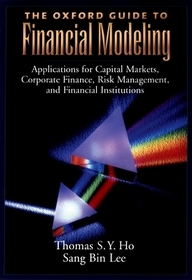
The Oxford Guide to Financial Modeling
Applications for Capital Markets, Corporate Finance, Risk Management and Financial Institutions
- Publisher's listprice GBP 202.50
-
91 428 Ft (87 075 Ft + 5% VAT)
The price is estimated because at the time of ordering we do not know what conversion rates will apply to HUF / product currency when the book arrives. In case HUF is weaker, the price increases slightly, in case HUF is stronger, the price goes lower slightly.
- Discount 10% (cc. 9 143 Ft off)
- Discounted price 82 286 Ft (78 368 Ft + 5% VAT)
Subcribe now and take benefit of a favourable price.
Subscribe
91 428 Ft

Availability
printed on demand
Why don't you give exact delivery time?
Delivery time is estimated on our previous experiences. We give estimations only, because we order from outside Hungary, and the delivery time mainly depends on how quickly the publisher supplies the book. Faster or slower deliveries both happen, but we do our best to supply as quickly as possible.
Product details:
- Publisher OUP USA
- Date of Publication 12 February 2004
- ISBN 9780195169621
- Binding Hardback
- No. of pages768 pages
- Size 185x257x43 mm
- Weight 1539 g
- Language English
- Illustrations numerous line figures 0
Categories
Short description:
The book discusses the theory and applications of more than 122 financial models currently in use and includes the financial models of stock and bond options, exotic options, investment grade and high-yield bonds, convertible bonds, mortgage-backed securities, liabilities of financial institutions' business models and corporate models.
MoreLong description:
The essential premise of this book is that theory and practice are equally important in describing financial modeling. In it the authors try to strike a balance in their discussions between theories that provide foundations for financial models and the institutional details that provide the context for applications of the models. The book presents the financial models of stock and bond options, exotic options, investment grade and high-yield bonds, convertible bonds, mortgage-backed securities, liabilities of financial institutions -- the business model and the corporate model. It also describes the applications of the models to corporate finance. Furthermore, it relates the models to financial statements, risk management for an enterprise, and asset/liability management with illiquid instruments. The financial models are progressively presented from option pricing in the securities markets to firm valuation in corporate finance, following a format to emphasize the three aspects of a model: the set of assumptions, the model specification, and the model applications. Generally, financial modeling books segment the world of finance as "investments," "financial institutions," "corporate finance," and "securities analysis," and in so doing they rarely emphasize the relationships between the subjects. This unique book successfully ties the thought processes and applications of the financial models together and describes them as one process that provides business solutions. Created as a companion website to the book readers can visit www.thomasho.com to gain deeper understanding of the book's financial models. Interested readers can build and test the models described in the book using Excel, and they can submit their models to the site. Readers can also use the site's forum to discuss the models and can browse server based models to gain insights into the applications of the models. For those using the book in meetings or class settings the site provides Power Point descriptions of the chapters. Students can use available question banks on the chapters for studying.
"This book showcases Dr. Ho's tireless journey into the frontier of finance over the years. It clearly demonstrates how various rigorous financial models can be practically incorporated into companies' strategic decision making and enterprise risk management. The book challenges our conventional thinking in capital structure theory, interest rate behavior and default risk pricing. It should provoke debate for many years to come." --Tony Kao, Managing Director, Global Fixed Income, General Motors Asset Management
Table of Contents:
PART 1. DERIVATIVES VALUATION
Introduction: Discounted Cash Flow Method
Equity Market: the Capital Asset Pricing Model
Bond Markets: the Bond Model
Equity Options: the Black-Scholes Model
Interest Rate Derivatives: Interest Rate Models
Implied Volatility Surface: Calibrating the Models
Exotic Options: Bellman's Optimization, Filtration Model and n-Factor Model
PART 2. CORPORATE LIABILITIES
Investment Grade Corporate Bonds: the Option Adjusted Spread
High Yield Corporate Bonds: the Structural Models
Convertibles, MBS/CMO, and Other Bonds: the Behavioral Models
Financial Institutions' Liabilities: Required Option Adjusted Spread
PART 3. CORPORATE FINANCE
Valuation of a Firm: the Business Model
Strategic Value of a Firm: Real Option
Optimal Corporate Financial Decisions: Corporate Model
Risk Management
Financial Institutions: Applications of Financial Models
Equity Options: the Black-Scholes Model
Concluding Thoughts
Epilogue: Market Model and Binomial Lattices
Notation

