

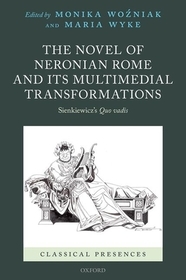
The Novel of Neronian Rome and its Multimedial Transformations
Sienkiewicz's Quo vadis
Sorozatcím: Classical Presences;
-
10% KEDVEZMÉNY?
- A kedvezmény csak az 'Értesítés a kedvenc témákról' hírlevelünk címzettjeinek rendeléseire érvényes.
- Kiadói listaár GBP 107.50
-
48 536 Ft (46 225 Ft + 5% áfa)
Az ár azért becsült, mert a rendelés pillanatában nem lehet pontosan tudni, hogy a beérkezéskor milyen lesz a forint árfolyama az adott termék eredeti devizájához képest. Ha a forint romlana, kissé többet, ha javulna, kissé kevesebbet kell majd fizetnie.
- Kedvezmény(ek) 10% (cc. 4 854 Ft off)
- Kedvezményes ár 43 683 Ft (41 603 Ft + 5% áfa)
Iratkozzon fel most és részesüljön kedvezőbb árainkból!
Feliratkozom
48 536 Ft

Beszerezhetőség
Megrendelésre a kiadó utánnyomja a könyvet. Rendelhető, de a szokásosnál kicsit lassabban érkezik meg.
Why don't you give exact delivery time?
A beszerzés időigényét az eddigi tapasztalatokra alapozva adjuk meg. Azért becsült, mert a terméket külföldről hozzuk be, így a kiadó kiszolgálásának pillanatnyi gyorsaságától is függ. A megadottnál gyorsabb és lassabb szállítás is elképzelhető, de mindent megteszünk, hogy Ön a lehető leghamarabb jusson hozzá a termékhez.
A termék adatai:
- Kiadó OUP Oxford
- Megjelenés dátuma 2020. december 16.
- ISBN 9780198867531
- Kötéstípus Keménykötés
- Terjedelem350 oldal
- Méret 240x165x25 mm
- Súly 720 g
- Nyelv angol 54
Kategóriák
Rövid leírás:
This volume explores the historical novel Quo vadis written by the Polish author Henryk Sienkiewicz, examining how Sienkiewicz recreated Neronian Rome so vividly and the reasons why his novel was so avidly consumed and reproduced in new editions, translations, visual illustrations, and adaptations to the stage and screen.
TöbbHosszú leírás:
The Polish writer Henryk Sienkiewicz was awarded the Nobel Prize for literature in 1905 largely on the basis of his historical novel Quo vadis: A Narrative of the Time of Nero. The novel's vivid and moving reconstruction of religious persecution and struggle against tyranny catapulted its author into literary stardom. But, before long, Quo vadis began to 'detach' itself from the person of its author and to become a multimedial, mass culture phenomenon. In the West and in the East, it was adapted for stage and screen, provided the inspiration for works of music and other genres of literature, was transformed into comic strips and illustrated children's books, was cited in advertising, and referenced in everyday objects of material culture. This volume explores the strategies Sienkiewicz used to recreate Neronian Rome and the reasons his novel was so avidly consumed and reproduced in new editions, translations, visual illustrations, and adaptations to the stage and screen across Europe and in the United States. The contributions render visible for English-speaking readers the impact of a Polish work of high literature on the presence of Nero, Christian persecution, and ancient Rome in Western popular culture.
His paper is based on intimate acquaintance with the rhythms, leaders and main themes of Polish classicism. This level of insight should appeal greatly to an anglophone audience, who will surely learn much from its observations on the importance of Latinity to the creation of a Polish national image, especially under the Russian and German occupations, and from its analysis of the ways in which the Polish language was masterfully employed to construct an inspirational but believable picture of Neronian Rome.
Tartalomjegyzék:
Introduction
I. Literary Context
The Paradoxes of Quo vadis: The Polish Classical Tradition in Action
Sienkiewicz and the Topography of Ancient Rome. The Riddle of Ostrianum in Quo vadis
Costumes in Henryk Sienkiewicz's Quo vadis and Their Literary and Painterly Sources
Quo vadis and Ancient Rome in the United States, 1896-1905
Comparing the Reception of Quo Vadis and Ben-Hur in the United States, 1896-1913
II. Quo vadis up to the Second World War
Quo vadis on the stage
Dangerous Liaisons: Quo vadis? (1913, dir. Enrico Guazzoni) and the Previous Theatrical Adaptations of Sienkiewicz's Novel
Word and Image: Competitive Adaptation in the Feature Film Quo vadis? (1913)
Illustrating Quo vadis in Italy (1900-1925): Between Cultivated Tradition and Popular Culture
Horror amid Sweetness: Kitsch and the Intertextual Strategies of Quo vadis Postcards
III. Quo vadis post the Second World War
'A more permanent world': Quo Vadis (1951), Runaway Production, and the Internationalisation of Hollywood
M-G-M's QVO VADIS: From Historical Fiction to Screen Spectacle
'O omnivorous powers, hail!': Film Dialogue in Quo Vadis (1951)
Ursus as a Serial Figure
The (In)discreet Charm of the Romans: Quo vadis (dir. Jerzy Kawalerowicz, 2001)

