

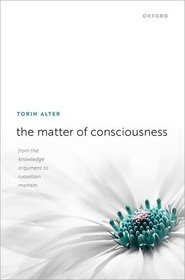
The Matter of Consciousness
From the Knowledge Argument to Russellian Monism
-
20% KEDVEZMÉNY?
- A kedvezmény csak az 'Értesítés a kedvenc témákról' hírlevelünk címzettjeinek rendeléseire érvényes.
- Kiadói listaár GBP 79.00
-
35 668 Ft (33 970 Ft + 5% áfa)
Az ár azért becsült, mert a rendelés pillanatában nem lehet pontosan tudni, hogy a beérkezéskor milyen lesz a forint árfolyama az adott termék eredeti devizájához képest. Ha a forint romlana, kissé többet, ha javulna, kissé kevesebbet kell majd fizetnie.
- Kedvezmény(ek) 20% (cc. 7 134 Ft off)
- Kedvezményes ár 28 535 Ft (27 176 Ft + 5% áfa)
- A kedvezmény érvényes eddig: 2026. június 30.
Iratkozzon fel most és részesüljön kedvezőbb árainkból!
Feliratkozom
35 668 Ft

Beszerezhetőség
Becsült beszerzési idő: A Prosperónál jelenleg nincsen raktáron, de a kiadónál igen. Beszerzés kb. 3-5 hét..
A Prosperónál jelenleg nincsen raktáron.
Why don't you give exact delivery time?
A beszerzés időigényét az eddigi tapasztalatokra alapozva adjuk meg. Azért becsült, mert a terméket külföldről hozzuk be, így a kiadó kiszolgálásának pillanatnyi gyorsaságától is függ. A megadottnál gyorsabb és lassabb szállítás is elképzelhető, de mindent megteszünk, hogy Ön a lehető leghamarabb jusson hozzá a termékhez.
A termék adatai:
- Kiadó OUP Oxford
- Megjelenés dátuma 2023. március 2.
- ISBN 9780198840459
- Kötéstípus Keménykötés
- Terjedelem280 oldal
- Méret 240x162x23 mm
- Súly 594 g
- Nyelv angol 284
Kategóriák
Rövid leírás:
Torin Alter makes a compelling case against the view that consciousness is a physical phenomenon. He argues that Frank Jackson's knowledge argument refutes all standard versions of physicalism, and leads to Russellian monism - the view there are intrinsic properties which both constitute consciousness and underlie properties described by physics.
TöbbHosszú leírás:
Torin Alter presents a compelling defence of the 'knowledge argument' against physicalism, pioneered by Frank Jackson. According to physicalism, consciousness is a physical phenomenon. The knowledge argument stars Mary, who learns all objective, physical information through black-and-white media and yet acquires new information when she first sees colors for herself: information about what it is like to see in color. Based partly on that case, Jackson concludes that not all information is physical. Alter argues that the knowledge argument succeeds in refuting all standard versions of physicalism: versions on which consciousness is grounded by what objective science reveals. Alter also argues that given further, plausible assumptions, the knowledge argument leads to Russellian monism, according to which there are intrinsic properties that both constitute consciousness and underlie properties described by physics, such as mass and charge. Alter explains how the knowledge argument establishes those two conclusions and defend it against numerous objections.
What can Mary know about the conscious experience of color from inside her black and white room, and what follows for the metaphysics of consciousness? Torin Alter gives a state-of-the-art analysis of these issues. He focuses especially on the crucial gap between structural and phenomenal aspects of reality, and articulates a powerful version of Russellian monism that traces this gap to a deep level of the physical world. Along the way he gives a definitive defense of anti-materialist arguments from objections old and new, shedding new light on this crucial nexus between consciousness, knowledge, and reality.
Tartalomjegyzék:
Part I: The case for the epistemic gap
Introduction
The significance of structure
Structure, physical knowledge, and ignorance
Phenomenal knowledge without experience
Non-propositional phenomenal knowledge
Phenomenal representation
Part II: The case for the modal gap
Deduction and necessity
Epistemic-modal bridge principles
The phenomenal concept strategy and Chalmers's dilemma
Consequences of social externalism
The conditional analysis of phenomenal concepts
Part III: The case for the ontological gap
The supervenience requirement on physicalism
Two final objections
Two final objections
The knowledge argument, Russellian monism, and causal integration
Conclusion

