

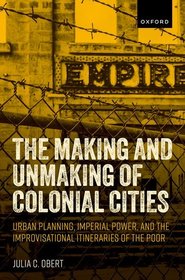
The Making and Unmaking of Colonial Cities
Urban Planning, Imperial Power, and the Improvisational Itineraries of the Poor
-
10% KEDVEZMÉNY?
- A kedvezmény csak az 'Értesítés a kedvenc témákról' hírlevelünk címzettjeinek rendeléseire érvényes.
- Kiadói listaár GBP 69.00
-
32 964 Ft (31 395 Ft + 5% áfa)
Az ár azért becsült, mert a rendelés pillanatában nem lehet pontosan tudni, hogy a beérkezéskor milyen lesz a forint árfolyama az adott termék eredeti devizájához képest. Ha a forint romlana, kissé többet, ha javulna, kissé kevesebbet kell majd fizetnie.
- Kedvezmény(ek) 10% (cc. 3 296 Ft off)
- Kedvezményes ár 29 668 Ft (28 256 Ft + 5% áfa)
Iratkozzon fel most és részesüljön kedvezőbb árainkból!
Feliratkozom
32 964 Ft

Beszerezhetőség
Becsült beszerzési idő: Várható beérkezés: 2026. január vége.
A Prosperónál jelenleg nincsen raktáron.
Why don't you give exact delivery time?
A beszerzés időigényét az eddigi tapasztalatokra alapozva adjuk meg. Azért becsült, mert a terméket külföldről hozzuk be, így a kiadó kiszolgálásának pillanatnyi gyorsaságától is függ. A megadottnál gyorsabb és lassabb szállítás is elképzelhető, de mindent megteszünk, hogy Ön a lehető leghamarabb jusson hozzá a termékhez.
A termék adatai:
- Kiadó OUP Oxford
- Megjelenés dátuma 2023. szeptember 21.
- ISBN 9780198881247
- Kötéstípus Keménykötés
- Terjedelem224 oldal
- Méret 242x163x13 mm
- Súly 490 g
- Nyelv angol 497
Kategóriák
Rövid leírás:
Obert explores the legacies of colonialism, racial segregation, and oppression in four post-colonial cities: Belfast, Windhoek, Bridgetown, and Hanoi. She uses local literary texts to demonstrate how bodies can move against repressive power through small gestures of reclamation.
TöbbHosszú leírás:
The Making and Unmaking of Colonial Cities is a comparative study of architectural space in four (post-)colonial capitals: Belfast, Northern Ireland; Windhoek, Namibia; Bridgetown, Barbados; and Hanoi, Vietnam. Each chapter takes up one of these cities, outlining its history of building and urban planning under colonial rule and linking that history to its contemporary shape and scope. This genealogical information is drawn from primary source documents and archival materials. The chapters then look to local literary texts to better understand the lingering impact of colonial building practices on individuals living in (post-)colonial cities today. These texts often foreground the difficulty of moving through a city that can never feel comfortably one's own; legacies of racial segregation, buildings that disregard indigenous resources, and street names that serve as constant reminders of a history of oppression, for example, can produce feelings of anxiety, even of unbelonging, for native subjects. However, the literature also highlights ways in which the subversive wanderings of particular pedestrians?taking shortcuts, trespassing in forbidden places, diverting spaces from their intended uses?can contest 'official' topography. Bodies can therefore move against the power of a repressive regime, at least to some degree, even when that power is literally set in stone. Obert argues for the significance of these small gestures of reclamation, suggesting that we must counterpose the potential flexibility of lived space to the prohibitions of the map in order to more fully understand (post-)colonial power relations.
TöbbTartalomjegyzék:
Introduction: Postcolonial Psychogeographies
"The grain of the city": Architectures of Subjection and Subversion in Belfast, Northern Ireland
'Ghost Spaces': The Colonial and Neocolonial Faces of Windhoek, Namibia
Of Cruise Ships and Chattel Houses: Built Space in Bridgetown, Barbados
The Thirty-Six Streets: Domination, Resistance, and the Power of Place in Hanoi, Vietnam
Conclusion: Stuctural Violence and Ecological Agency
Works cited

