

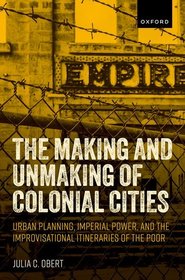
The Making and Unmaking of Colonial Cities
Urban Planning, Imperial Power, and the Improvisational Itineraries of the Poor
- Publisher's listprice GBP 69.00
-
32 964 Ft (31 395 Ft + 5% VAT)
The price is estimated because at the time of ordering we do not know what conversion rates will apply to HUF / product currency when the book arrives. In case HUF is weaker, the price increases slightly, in case HUF is stronger, the price goes lower slightly.
- Discount 10% (cc. 3 296 Ft off)
- Discounted price 29 668 Ft (28 256 Ft + 5% VAT)
Subcribe now and take benefit of a favourable price.
Subscribe
32 964 Ft

Availability
Estimated delivery time: Expected time of arrival: end of January 2026.
Not in stock at Prospero.
Why don't you give exact delivery time?
Delivery time is estimated on our previous experiences. We give estimations only, because we order from outside Hungary, and the delivery time mainly depends on how quickly the publisher supplies the book. Faster or slower deliveries both happen, but we do our best to supply as quickly as possible.
Product details:
- Publisher OUP Oxford
- Date of Publication 21 September 2023
- ISBN 9780198881247
- Binding Hardback
- No. of pages224 pages
- Size 242x163x13 mm
- Weight 490 g
- Language English 497
Categories
Short description:
Obert explores the legacies of colonialism, racial segregation, and oppression in four post-colonial cities: Belfast, Windhoek, Bridgetown, and Hanoi. She uses local literary texts to demonstrate how bodies can move against repressive power through small gestures of reclamation.
MoreLong description:
The Making and Unmaking of Colonial Cities is a comparative study of architectural space in four (post-)colonial capitals: Belfast, Northern Ireland; Windhoek, Namibia; Bridgetown, Barbados; and Hanoi, Vietnam. Each chapter takes up one of these cities, outlining its history of building and urban planning under colonial rule and linking that history to its contemporary shape and scope. This genealogical information is drawn from primary source documents and archival materials. The chapters then look to local literary texts to better understand the lingering impact of colonial building practices on individuals living in (post-)colonial cities today. These texts often foreground the difficulty of moving through a city that can never feel comfortably one's own; legacies of racial segregation, buildings that disregard indigenous resources, and street names that serve as constant reminders of a history of oppression, for example, can produce feelings of anxiety, even of unbelonging, for native subjects. However, the literature also highlights ways in which the subversive wanderings of particular pedestrians?taking shortcuts, trespassing in forbidden places, diverting spaces from their intended uses?can contest 'official' topography. Bodies can therefore move against the power of a repressive regime, at least to some degree, even when that power is literally set in stone. Obert argues for the significance of these small gestures of reclamation, suggesting that we must counterpose the potential flexibility of lived space to the prohibitions of the map in order to more fully understand (post-)colonial power relations.
MoreTable of Contents:
Introduction: Postcolonial Psychogeographies
"The grain of the city": Architectures of Subjection and Subversion in Belfast, Northern Ireland
'Ghost Spaces': The Colonial and Neocolonial Faces of Windhoek, Namibia
Of Cruise Ships and Chattel Houses: Built Space in Bridgetown, Barbados
The Thirty-Six Streets: Domination, Resistance, and the Power of Place in Hanoi, Vietnam
Conclusion: Stuctural Violence and Ecological Agency
Works cited

