

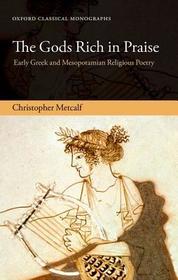
The Gods Rich in Praise
Early Greek and Mesopotamian Religious Poetry
Sorozatcím: Oxford Classical Monographs;
-
10% KEDVEZMÉNY?
- A kedvezmény csak az 'Értesítés a kedvenc témákról' hírlevelünk címzettjeinek rendeléseire érvényes.
- Kiadói listaár GBP 122.50
-
55 308 Ft (52 675 Ft + 5% áfa)
Az ár azért becsült, mert a rendelés pillanatában nem lehet pontosan tudni, hogy a beérkezéskor milyen lesz a forint árfolyama az adott termék eredeti devizájához képest. Ha a forint romlana, kissé többet, ha javulna, kissé kevesebbet kell majd fizetnie.
- Kedvezmény(ek) 10% (cc. 5 531 Ft off)
- Kedvezményes ár 49 778 Ft (47 408 Ft + 5% áfa)
Iratkozzon fel most és részesüljön kedvezőbb árainkból!
Feliratkozom
55 308 Ft

Beszerezhetőség
Megrendelésre a kiadó utánnyomja a könyvet. Rendelhető, de a szokásosnál kicsit lassabban érkezik meg.
Why don't you give exact delivery time?
A beszerzés időigényét az eddigi tapasztalatokra alapozva adjuk meg. Azért becsült, mert a terméket külföldről hozzuk be, így a kiadó kiszolgálásának pillanatnyi gyorsaságától is függ. A megadottnál gyorsabb és lassabb szállítás is elképzelhető, de mindent megteszünk, hogy Ön a lehető leghamarabb jusson hozzá a termékhez.
A termék adatai:
- Kiadó OUP Oxford
- Megjelenés dátuma 2015. április 30.
- ISBN 9780198723363
- Kötéstípus Keménykötés
- Terjedelem304 oldal
- Méret 219x156x23 mm
- Súly 490 g
- Nyelv angol 0
Kategóriák
Rövid leírás:
This volume examines the question of whether early Greek poetry was inspired by texts from the neighbouring civilizations of the ancient Near East, especially Mesopotamia.
TöbbHosszú leírás:
Many scholars today believe that early Greek literature, as represented by the great poems of Homer and Hesiod, was to some extent inspired by texts from the neighbouring civilizations of the ancient Near East, especially Mesopotamia. It is true that, in the case of religious poetry, early Greek poets sang about their gods in ways that resemble those of Sumerian or Akkadian hymns from Mesopotamia, but does this mean that the latter influenced the former, and if so, how? This volume is the first to attempt an answer to these questions by undertaking a detailed study of the ancient texts in their original languages, from Sumerian poetry in the 20th century BC to Greek sources from the times of Homer, Hesiod, Pindar, and Aeschylus.
The Gods Rich in Praise presents the core groups of sources from the ancient Near East, describing the main features of style and content of Sumerian and Akkadian religious poetry, and showing how certain compositions were translated and adapted beyond Mesopotamia. It proceeds by comparing selected elements of form and content: hymnic openings, negative predication, the birth of Aphrodite in the Theogony of Hesiod, and the origins and development of a phrase in Hittite prayers and the Iliad of Homer. The volume concludes that, in terms of form and style, early Greek religious poetry was probably not indebted to ancient Near Eastern models, but also argues that such influence may nevertheless be perceived in certain closely defined instances, particularly where supplementary evidence from other ancient sources is available, and where the extant sources permit a reconstruction of the process of translation and adaptation.
The Gods Rich in Praise sets a new standard for work on the relationship between Greek and Near Eastern literature, and will be a standard reference point for anyone who wants to do serious work in this area in future.
Tartalomjegyzék:
Acknowledgements
Abbreviations
Conventions
Introduction
Sumerian Hymns of the Old Babylonian Period
Akkadian Hymns of the Old Babylonian Period
The Hittite Evidence in the Light of the Old Babylonian Sources
Introductory Remarks on the Early Greek and Mesopotamian Sources
Hymnic Openings
A Case of Negative Predication
Variations on the Names of the Goddess
Sumerian and Hittite Notes on Iliad 1.62-4
Conclusion
Catalogue A: Old Babylonian Hymns
Catalogue B: Old Babylonian Akkadian Hymns
Catalogue C: Hittite Hymns
Catalogue D: Greek Hymns and Authors
References

