

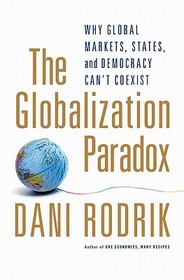
The Globalization Paradox
Why Global Markets, States, and Democracy Can't Coexist
-
10% KEDVEZMÉNY?
- A kedvezmény csak az 'Értesítés a kedvenc témákról' hírlevelünk címzettjeinek rendeléseire érvényes.
- Kiadói listaár GBP 16.99
-
8 116 Ft (7 730 Ft + 5% áfa)
Az ár azért becsült, mert a rendelés pillanatában nem lehet pontosan tudni, hogy a beérkezéskor milyen lesz a forint árfolyama az adott termék eredeti devizájához képest. Ha a forint romlana, kissé többet, ha javulna, kissé kevesebbet kell majd fizetnie.
- Kedvezmény(ek) 10% (cc. 812 Ft off)
- Kedvezményes ár 7 305 Ft (6 957 Ft + 5% áfa)
Iratkozzon fel most és részesüljön kedvezőbb árainkból!
Feliratkozom
8 116 Ft

Beszerezhetőség
A kiadónál véglegesen elfogyott, nem rendelhető. Érdemes újra keresni a címmel, hátha van újabb kiadás.
Why don't you give exact delivery time?
A beszerzés időigényét az eddigi tapasztalatokra alapozva adjuk meg. Azért becsült, mert a terméket külföldről hozzuk be, így a kiadó kiszolgálásának pillanatnyi gyorsaságától is függ. A megadottnál gyorsabb és lassabb szállítás is elképzelhető, de mindent megteszünk, hogy Ön a lehető leghamarabb jusson hozzá a termékhez.
A termék adatai:
- Kiadó Oxford University Press
- Megjelenés dátuma 2011. március 24.
- ISBN 9780199603336
- Kötéstípus Keménykötés
- Terjedelem368 oldal
- Méret 242x155x25 mm
- Súly 670 g
- Nyelv angol 0
Kategóriák
Rövid leírás:
Globalization, Rodrik argues, rests on shaky foundations. Despite the benefits it has brought to much of the world, there are profound conflicts of interest between democracy, national determination, and full economic globalization. He traces the idea's history, pinpoints its weaknesses, and points the way forward to a new 'smart globalization'
TöbbHosszú leírás:
For a century, economists have driven forward the cause of globalization in financial institutions, labour markets, and trade. Yet there have been consistent warning signs that a global economy and free trade might not always be advantageous. Where are the pressure points? What could be done about them?
Dani Rodrik examines the back-story from its seventeenth-century origins through the milestones of the gold standard, the Bretton Woods Agreement, and the Washington Consensus, to the present day. Although economic globalization has enabled unprecedented levels of prosperity in advanced countries and has been a boon to hundreds of millions of poor workers in China and elsewhere in Asia, it is a concept that rests on shaky pillars, he contends. Its long-term sustainability is not a given.
The heart of Rodrik 's argument is a fundamental 'trilemma': that we cannot simultaneously pursue democracy, national self-determination, and economic globalization. Give too much power to governments, and you have protectionism. Give markets too much freedom, and you have an unstable world economy with little social and political support from those it is supposed to help. Rodrik argues for smart globalization, not maximum globalization.
This book takes on the biggest issue of our time - globalization - and eloquently enlarges the debate about the extent and limits of global cooperation.
Tartalomjegyzék:
Introduction: Recasting Globalization's Narrative
Of States and Markets: Globalization in History's Mirror
The Rise and Fall of the First Great Globalization
Why Doesn't Everyone Get the Case for Free Trade?
Bretton Woods, GATT, and the WTO: Trade in a Politicized World
Financial Globalization Follies
The Foxes and Hedgehogs of Finance
Poor Countries in a Rich World
Trade Fundamentalism in the Tropics
The Political Trilemma of the World Economy
Is Global Governance Feasible? Is It Desirable?
Designing Capitalism
A Sane Globalization
Afterword: A Bedtime Story for Grown-ups

