

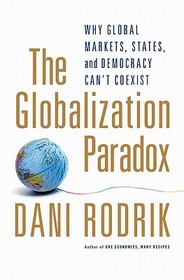
The Globalization Paradox
Why Global Markets, States, and Democracy Can't Coexist
- Publisher's listprice GBP 16.99
-
8 116 Ft (7 730 Ft + 5% VAT)
The price is estimated because at the time of ordering we do not know what conversion rates will apply to HUF / product currency when the book arrives. In case HUF is weaker, the price increases slightly, in case HUF is stronger, the price goes lower slightly.
- Discount 10% (cc. 812 Ft off)
- Discounted price 7 305 Ft (6 957 Ft + 5% VAT)
Subcribe now and take benefit of a favourable price.
Subscribe
8 116 Ft

Availability
Out of print
Why don't you give exact delivery time?
Delivery time is estimated on our previous experiences. We give estimations only, because we order from outside Hungary, and the delivery time mainly depends on how quickly the publisher supplies the book. Faster or slower deliveries both happen, but we do our best to supply as quickly as possible.
Product details:
- Publisher Oxford University Press
- Date of Publication 24 March 2011
- ISBN 9780199603336
- Binding Hardback
- No. of pages368 pages
- Size 242x155x25 mm
- Weight 670 g
- Language English 0
Categories
Short description:
Globalization, Rodrik argues, rests on shaky foundations. Despite the benefits it has brought to much of the world, there are profound conflicts of interest between democracy, national determination, and full economic globalization. He traces the idea's history, pinpoints its weaknesses, and points the way forward to a new 'smart globalization'
MoreLong description:
For a century, economists have driven forward the cause of globalization in financial institutions, labour markets, and trade. Yet there have been consistent warning signs that a global economy and free trade might not always be advantageous. Where are the pressure points? What could be done about them?
Dani Rodrik examines the back-story from its seventeenth-century origins through the milestones of the gold standard, the Bretton Woods Agreement, and the Washington Consensus, to the present day. Although economic globalization has enabled unprecedented levels of prosperity in advanced countries and has been a boon to hundreds of millions of poor workers in China and elsewhere in Asia, it is a concept that rests on shaky pillars, he contends. Its long-term sustainability is not a given.
The heart of Rodrik 's argument is a fundamental 'trilemma': that we cannot simultaneously pursue democracy, national self-determination, and economic globalization. Give too much power to governments, and you have protectionism. Give markets too much freedom, and you have an unstable world economy with little social and political support from those it is supposed to help. Rodrik argues for smart globalization, not maximum globalization.
This book takes on the biggest issue of our time - globalization - and eloquently enlarges the debate about the extent and limits of global cooperation.
Table of Contents:
Introduction: Recasting Globalization's Narrative
Of States and Markets: Globalization in History's Mirror
The Rise and Fall of the First Great Globalization
Why Doesn't Everyone Get the Case for Free Trade?
Bretton Woods, GATT, and the WTO: Trade in a Politicized World
Financial Globalization Follies
The Foxes and Hedgehogs of Finance
Poor Countries in a Rich World
Trade Fundamentalism in the Tropics
The Political Trilemma of the World Economy
Is Global Governance Feasible? Is It Desirable?
Designing Capitalism
A Sane Globalization
Afterword: A Bedtime Story for Grown-ups

