

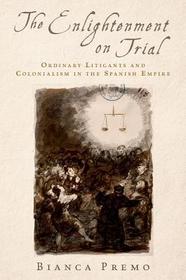
The Enlightenment on Trial
Ordinary Litigants and Colonialism in the Spanish Empire
-
10% KEDVEZMÉNY?
- A kedvezmény csak az 'Értesítés a kedvenc témákról' hírlevelünk címzettjeinek rendeléseire érvényes.
- Kiadói listaár GBP 135.00
-
64 496 Ft (61 425 Ft + 5% áfa)
Az ár azért becsült, mert a rendelés pillanatában nem lehet pontosan tudni, hogy a beérkezéskor milyen lesz a forint árfolyama az adott termék eredeti devizájához képest. Ha a forint romlana, kissé többet, ha javulna, kissé kevesebbet kell majd fizetnie.
- Kedvezmény(ek) 10% (cc. 6 450 Ft off)
- Kedvezményes ár 58 047 Ft (55 283 Ft + 5% áfa)
Iratkozzon fel most és részesüljön kedvezőbb árainkból!
Feliratkozom
64 496 Ft

Beszerezhetőség
Megrendelésre a kiadó utánnyomja a könyvet. Rendelhető, de a szokásosnál kicsit lassabban érkezik meg.
Why don't you give exact delivery time?
A beszerzés időigényét az eddigi tapasztalatokra alapozva adjuk meg. Azért becsült, mert a terméket külföldről hozzuk be, így a kiadó kiszolgálásának pillanatnyi gyorsaságától is függ. A megadottnál gyorsabb és lassabb szállítás is elképzelhető, de mindent megteszünk, hogy Ön a lehető leghamarabb jusson hozzá a termékhez.
A termék adatai:
- Kiadó OUP USA
- Megjelenés dátuma 2017. április 20.
- ISBN 9780190638726
- Kötéstípus Keménykötés
- Terjedelem384 oldal
- Méret 160x239x27 mm
- Súly 771 g
- Nyelv angol
- Illusztrációk 25 illus. 0
Kategóriák
Rövid leírás:
The principal protagonists of this history of the Enlightenment are non-literate, poor, and enslaved colonial litigants who began to sue their superiors in the royal courts of the Spanish empire. With comparative data on civil litigation and close readings of the lawsuits, The Enlightenment on Trial explores how ordinary Spanish Americans actively produced modern concepts of law.
TöbbHosszú leírás:
This is a history not of an Enlightenment but rather the Enlightenment--the rights-oriented, formalist, secularizing, freedom-inspired eighteenth-century movement that defined modern Western law. Its principal protagonists, rather than members of a cosmopolitan Republic of Letters, are non-literate, poor, and enslaved litigants who sued their superiors in the royal courts of Spain's American colonies.
Despite growing evidence of the Hispanic world's contributions to Enlightenment science, the writing of history, and statecraft, it is conventionally believed to have taken an alternate route to modernity. This book grapples with the contradiction between this legacy and eighteenth-century Spanish Americans' active production of concepts fundamental to modern law. The book is intensely empirical even as it is sly situated within current theoretical debates about imperial geographies of history. The Enlightenment on Trial offers readers new insight into how legal documents were made, fresh interpretations of the intellectual transformations and legal reform policies of the period, and comparative analysis of the volume of civil suits from six regions in Mexico, Peru and Spain.
Ordinary litigants in the colonies-far more often than peninsular Spaniards-sued superiors at an accelerating pace in the second half of the eighteenth century. Three types of cases increased even faster than a stunning general rise of civil suits in the colonies: those that slaves, native peasants and women initiated against masters, native leaders and husbands. As they entered court, these litigants advanced a new law-centered culture distinct from the casuistic, justice-oriented legal culture of the early modern period. And they did so at precisely the same time that a few bright minds of Europe enshrined them in print. The conclusion considers why, if this is so, the Spanish empire has remained marginal to the story of the advent of the modern West.
A truly brilliant study that changes the field as we know it....The combined force of Premo's numerical data and her culturalist analysis of the cases is overwhelming. She is simply right
Tartalomjegyzék:
Acknowledgments
Notes on Laws
Introduction Why is it Enlightenment?
Part I: Suing in the Spanish Empire
Chapter 1 Agents and Powers: Litigants and Writers in the Courts
Chapter 2 Derecho and Law: Legal Enlightenment in Philosophy and Policy
Chapter 3 Numbers and Values: Counting Cases in the Spanish Empire
Part II: Lights from Litigants
Chapter 4 Pleitos and Lawsuits: Conjugal Conflicts in Civil Courts
Chapter 5 Then and Now: Native Status and Custom
Chapter 6 Being and Becoming: Freedom and Slave Lawsuits
Conclusion Why Not Enlightenment?
Appendix I Archival Methods
Appendix II Analysis of Civil Litigation over Time
Archival Abbreviations
Notes
Bibliography
Index

