

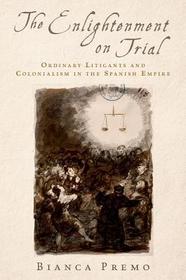
The Enlightenment on Trial
Ordinary Litigants and Colonialism in the Spanish Empire
- Publisher's listprice GBP 135.00
-
64 496 Ft (61 425 Ft + 5% VAT)
The price is estimated because at the time of ordering we do not know what conversion rates will apply to HUF / product currency when the book arrives. In case HUF is weaker, the price increases slightly, in case HUF is stronger, the price goes lower slightly.
- Discount 10% (cc. 6 450 Ft off)
- Discounted price 58 047 Ft (55 283 Ft + 5% VAT)
Subcribe now and take benefit of a favourable price.
Subscribe
64 496 Ft

Availability
printed on demand
Why don't you give exact delivery time?
Delivery time is estimated on our previous experiences. We give estimations only, because we order from outside Hungary, and the delivery time mainly depends on how quickly the publisher supplies the book. Faster or slower deliveries both happen, but we do our best to supply as quickly as possible.
Product details:
- Publisher OUP USA
- Date of Publication 20 April 2017
- ISBN 9780190638726
- Binding Hardback
- No. of pages384 pages
- Size 160x239x27 mm
- Weight 771 g
- Language English
- Illustrations 25 illus. 0
Categories
Short description:
The principal protagonists of this history of the Enlightenment are non-literate, poor, and enslaved colonial litigants who began to sue their superiors in the royal courts of the Spanish empire. With comparative data on civil litigation and close readings of the lawsuits, The Enlightenment on Trial explores how ordinary Spanish Americans actively produced modern concepts of law.
MoreLong description:
This is a history not of an Enlightenment but rather the Enlightenment--the rights-oriented, formalist, secularizing, freedom-inspired eighteenth-century movement that defined modern Western law. Its principal protagonists, rather than members of a cosmopolitan Republic of Letters, are non-literate, poor, and enslaved litigants who sued their superiors in the royal courts of Spain's American colonies.
Despite growing evidence of the Hispanic world's contributions to Enlightenment science, the writing of history, and statecraft, it is conventionally believed to have taken an alternate route to modernity. This book grapples with the contradiction between this legacy and eighteenth-century Spanish Americans' active production of concepts fundamental to modern law. The book is intensely empirical even as it is sly situated within current theoretical debates about imperial geographies of history. The Enlightenment on Trial offers readers new insight into how legal documents were made, fresh interpretations of the intellectual transformations and legal reform policies of the period, and comparative analysis of the volume of civil suits from six regions in Mexico, Peru and Spain.
Ordinary litigants in the colonies-far more often than peninsular Spaniards-sued superiors at an accelerating pace in the second half of the eighteenth century. Three types of cases increased even faster than a stunning general rise of civil suits in the colonies: those that slaves, native peasants and women initiated against masters, native leaders and husbands. As they entered court, these litigants advanced a new law-centered culture distinct from the casuistic, justice-oriented legal culture of the early modern period. And they did so at precisely the same time that a few bright minds of Europe enshrined them in print. The conclusion considers why, if this is so, the Spanish empire has remained marginal to the story of the advent of the modern West.
A truly brilliant study that changes the field as we know it....The combined force of Premo's numerical data and her culturalist analysis of the cases is overwhelming. She is simply right
Table of Contents:
Acknowledgments
Notes on Laws
Introduction Why is it Enlightenment?
Part I: Suing in the Spanish Empire
Chapter 1 Agents and Powers: Litigants and Writers in the Courts
Chapter 2 Derecho and Law: Legal Enlightenment in Philosophy and Policy
Chapter 3 Numbers and Values: Counting Cases in the Spanish Empire
Part II: Lights from Litigants
Chapter 4 Pleitos and Lawsuits: Conjugal Conflicts in Civil Courts
Chapter 5 Then and Now: Native Status and Custom
Chapter 6 Being and Becoming: Freedom and Slave Lawsuits
Conclusion Why Not Enlightenment?
Appendix I Archival Methods
Appendix II Analysis of Civil Litigation over Time
Archival Abbreviations
Notes
Bibliography
Index

