

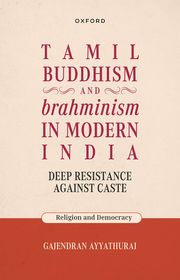
Tamil Buddhism and brahminism in Modern India
Deep Resistance against Caste
Sorozatcím: Religion and Democracy;
-
10% KEDVEZMÉNY?
- A kedvezmény csak az 'Értesítés a kedvenc témákról' hírlevelünk címzettjeinek rendeléseire érvényes.
- Kiadói listaár GBP 119.00
-
53 728 Ft (51 170 Ft + 5% áfa)
Az ár azért becsült, mert a rendelés pillanatában nem lehet pontosan tudni, hogy a beérkezéskor milyen lesz a forint árfolyama az adott termék eredeti devizájához képest. Ha a forint romlana, kissé többet, ha javulna, kissé kevesebbet kell majd fizetnie.
- Kedvezmény(ek) 10% (cc. 5 373 Ft off)
- Kedvezményes ár 48 356 Ft (46 053 Ft + 5% áfa)
Iratkozzon fel most és részesüljön kedvezőbb árainkból!
Feliratkozom
53 728 Ft

Beszerezhetőség
Megrendelésre a kiadó utánnyomja a könyvet. Rendelhető, de a szokásosnál kicsit lassabban érkezik meg.
Why don't you give exact delivery time?
A beszerzés időigényét az eddigi tapasztalatokra alapozva adjuk meg. Azért becsült, mert a terméket külföldről hozzuk be, így a kiadó kiszolgálásának pillanatnyi gyorsaságától is függ. A megadottnál gyorsabb és lassabb szállítás is elképzelhető, de mindent megteszünk, hogy Ön a lehető leghamarabb jusson hozzá a termékhez.
A termék adatai:
- Kiadó OUP Oxford
- Megjelenés dátuma 2025. december 9.
- ISBN 9780198952398
- Kötéstípus Keménykötés
- Terjedelem390 oldal
- Méret 26x140x216 mm
- Súly 585 g
- Nyelv angol 661
Kategóriák
Rövid leírás:
This book uncovers the radical intellectual history of Tamil Buddhism as a response to caste oppression, led by Pandit Iyothee Thass. It explores casteless identity, feminist critique, and vernacular emancipation through Critical Caste Studies, highlighting Buddhist resistance to brahminism in modern India.
TöbbHosszú leírás:
This book explores Tamil Buddhism in modern India, focusing on its emergence as a response to caste-based oppression during the late nineteenth and early twentieth centuries. Central to this movement was Pandit Iyothee Thass (1845?1914), a pioneering intellectual who reinterpreted India?s Buddhist past to challenge brahminical dominance. Thass reasoned that it was because many Indians followed Buddhist cultural and material traditions in ancient times, they were oppressed as untouchables and lower castes by self-privileging-caste groups, such as brahmins. Thus, Thass challenged brahminism/casteism in India by reconstructing and mobilizing a reading public about the casteless Buddhist history of Indians who were prone to caste oppression. His writings, petitions, and archives reveal the castelessness of Tamil Buddhists and their commitment for a radical political transformation in modern India. Key aspects of the Tamil Buddhist movement include public mobilization for caste-free societies, self-representation of oppressed communities, economic redistribution through affirmative action, and a feminist critique of caste and patriarchy. Through interdisciplinary methods from Critical Caste Studies, this monograph uncovers the intellectual history of Tamil Buddhism and its radical call for vernacular emancipation. It highlights how Indigenous, Tamil/Indian communities used Buddhist foundations to resist caste and envision a modern, casteless future.
Több
