

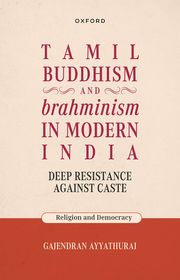
Tamil Buddhism and brahminism in Modern India
Deep Resistance against Caste
Series: Religion and Democracy;
- Publisher's listprice GBP 119.00
-
53 728 Ft (51 170 Ft + 5% VAT)
The price is estimated because at the time of ordering we do not know what conversion rates will apply to HUF / product currency when the book arrives. In case HUF is weaker, the price increases slightly, in case HUF is stronger, the price goes lower slightly.
- Discount 10% (cc. 5 373 Ft off)
- Discounted price 48 356 Ft (46 053 Ft + 5% VAT)
Subcribe now and take benefit of a favourable price.
Subscribe
53 728 Ft

Availability
printed on demand
Why don't you give exact delivery time?
Delivery time is estimated on our previous experiences. We give estimations only, because we order from outside Hungary, and the delivery time mainly depends on how quickly the publisher supplies the book. Faster or slower deliveries both happen, but we do our best to supply as quickly as possible.
Product details:
- Publisher OUP Oxford
- Date of Publication 9 December 2025
- ISBN 9780198952398
- Binding Hardback
- No. of pages390 pages
- Size 26x140x216 mm
- Weight 585 g
- Language English 661
Categories
Short description:
This book uncovers the radical intellectual history of Tamil Buddhism as a response to caste oppression, led by Pandit Iyothee Thass. It explores casteless identity, feminist critique, and vernacular emancipation through Critical Caste Studies, highlighting Buddhist resistance to brahminism in modern India.
MoreLong description:
This book explores Tamil Buddhism in modern India, focusing on its emergence as a response to caste-based oppression during the late nineteenth and early twentieth centuries. Central to this movement was Pandit Iyothee Thass (1845?1914), a pioneering intellectual who reinterpreted India?s Buddhist past to challenge brahminical dominance. Thass reasoned that it was because many Indians followed Buddhist cultural and material traditions in ancient times, they were oppressed as untouchables and lower castes by self-privileging-caste groups, such as brahmins. Thus, Thass challenged brahminism/casteism in India by reconstructing and mobilizing a reading public about the casteless Buddhist history of Indians who were prone to caste oppression. His writings, petitions, and archives reveal the castelessness of Tamil Buddhists and their commitment for a radical political transformation in modern India. Key aspects of the Tamil Buddhist movement include public mobilization for caste-free societies, self-representation of oppressed communities, economic redistribution through affirmative action, and a feminist critique of caste and patriarchy. Through interdisciplinary methods from Critical Caste Studies, this monograph uncovers the intellectual history of Tamil Buddhism and its radical call for vernacular emancipation. It highlights how Indigenous, Tamil/Indian communities used Buddhist foundations to resist caste and envision a modern, casteless future.
More
