

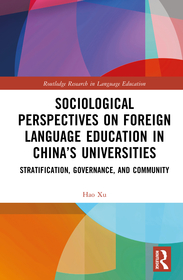
Sociological Perspectives on Foreign Language Education in China’s Universities
Stratification, Governance, and Community
Sorozatcím: Routledge Research in Language Education;
-
20% KEDVEZMÉNY?
- A kedvezmény csak az 'Értesítés a kedvenc témákról' hírlevelünk címzettjeinek rendeléseire érvényes.
- Kiadói listaár GBP 155.00
-
69 982 Ft (66 650 Ft + 5% áfa)
Az ár azért becsült, mert a rendelés pillanatában nem lehet pontosan tudni, hogy a beérkezéskor milyen lesz a forint árfolyama az adott termék eredeti devizájához képest. Ha a forint romlana, kissé többet, ha javulna, kissé kevesebbet kell majd fizetnie.
- Kedvezmény(ek) 20% (cc. 13 996 Ft off)
- Kedvezményes ár 55 986 Ft (53 320 Ft + 5% áfa)
- A kedvezmény érvényes eddig: 2026. június 30.
Iratkozzon fel most és részesüljön kedvezőbb árainkból!
Feliratkozom
62 984 Ft

Beszerezhetőség
Becsült beszerzési idő: A Prosperónál jelenleg nincsen raktáron, de a kiadónál igen. Beszerzés kb. 3-5 hét..
A Prosperónál jelenleg nincsen raktáron.
Why don't you give exact delivery time?
A beszerzés időigényét az eddigi tapasztalatokra alapozva adjuk meg. Azért becsült, mert a terméket külföldről hozzuk be, így a kiadó kiszolgálásának pillanatnyi gyorsaságától is függ. A megadottnál gyorsabb és lassabb szállítás is elképzelhető, de mindent megteszünk, hogy Ön a lehető leghamarabb jusson hozzá a termékhez.
A termék adatai:
- Kiadás sorszáma 1
- Kiadó Routledge
- Megjelenés dátuma 2026. március 11.
- ISBN 9781041010241
- Kötéstípus Keménykötés
- Terjedelem228 oldal
- Méret 234x156 mm
- Súly 580 g
- Nyelv angol
- Illusztrációk 6 Tables, black & white 686
Kategóriák
Rövid leírás:
Xu explores the intricate dynamics between teaching and research, economic considerations, and individual and community interactions. This appeals to scholars of language education and language policy, along with policymakers, university administrators, and educators interested in the complexities of foreign language education in China.
TöbbHosszú leírás:
Through a comprehensive sociological examination of foreign language education within Chinese universities, Xu focuses on the intricate dynamics between teaching and research, economic considerations, and individual and community interactions.
Through nine qualitative studies, the book explores the underlying structures and processes that shape the experiences of faculty members and the evolution of language education policies. It offers detailed insights into the sociological structures and hierarchies within foreign language education in China’s universities and uncovers how economic motives influence policy development and institutional practices in higher education. The content uses rich, qualitative case studies to provide real-world insights into the lived experiences of faculty members. The book explores the implications of policy and practice through a critical sociological lens, offering a unique viewpoint on language education.
This book is essential reading for scholars and students of language education and language policy. It will also appeal to policymakers, university administrators, and educators interested in the complexities of foreign language education in China and the broader implications for higher education systems worldwide.
TöbbTartalomjegyzék:
Chapter 1 Introduction
Chapter 2 Stratification and Hierarchy in Teaching and Research
2.1 Teaching vs. research: Division of labour or labour transfer?
2.2 Collective burnout among senior university foreign language teachers
2.3 Open access publishing community for marginalised academics
Chapter 3 The “Macroeconomics” of Foreign Language Education in Universities
3.1 Expansion of undergraduate education and programmes development
3.2 Postgraduate education planning: Moderating academic and professional quotas
3.3 Endogenous policies and internal resource circulation
Chapter 4 Individuals, Activities, Communities and Structure
4.1 Psychological empowerment of up-or-out faculty
4.2 Rewards: Power-based subsidy or compensation for labour?
4.3 Professional development workshops: Structure that mediates alienating effects
Chapter 5 Conclusion
Több
