

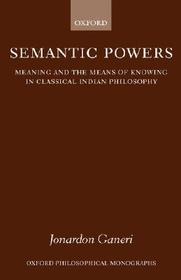
Semantic Powers
Meaning and the Means of Knowing in Classical Indian Philosophy
Sorozatcím: Oxford Philosophical Monographs;
-
10% KEDVEZMÉNY?
- A kedvezmény csak az 'Értesítés a kedvenc témákról' hírlevelünk címzettjeinek rendeléseire érvényes.
- Kiadói listaár GBP 150.00
-
67 725 Ft (64 500 Ft + 5% áfa)
Az ár azért becsült, mert a rendelés pillanatában nem lehet pontosan tudni, hogy a beérkezéskor milyen lesz a forint árfolyama az adott termék eredeti devizájához képest. Ha a forint romlana, kissé többet, ha javulna, kissé kevesebbet kell majd fizetnie.
- Kedvezmény(ek) 10% (cc. 6 773 Ft off)
- Kedvezményes ár 60 953 Ft (58 050 Ft + 5% áfa)
Iratkozzon fel most és részesüljön kedvezőbb árainkból!
Feliratkozom
67 725 Ft

Beszerezhetőség
Megrendelésre a kiadó utánnyomja a könyvet. Rendelhető, de a szokásosnál kicsit lassabban érkezik meg.
Why don't you give exact delivery time?
A beszerzés időigényét az eddigi tapasztalatokra alapozva adjuk meg. Azért becsült, mert a terméket külföldről hozzuk be, így a kiadó kiszolgálásának pillanatnyi gyorsaságától is függ. A megadottnál gyorsabb és lassabb szállítás is elképzelhető, de mindent megteszünk, hogy Ön a lehető leghamarabb jusson hozzá a termékhez.
A termék adatai:
- Kiadó OUP Oxford
- Megjelenés dátuma 1999. március 25.
- ISBN 9780198237884
- Kötéstípus Keménykötés
- Terjedelem280 oldal
- Méret 225x144x20 mm
- Súly 452 g
- Nyelv angol 0
Kategóriák
Rövid leírás:
Jonardon Ganeri gives an account of language as essentially a means for the reception of knowledge. The semantic power of a word, its ability to stand for a thing, derives from the capacity of understanders to acquire knowledge simply by understanding what is said. Ganeri finds this account in the work of certain Indian philosophers of language, and shows how their analysis can inform and be informed by contemporary philosophical theory.
TöbbHosszú leírás:
Jonardon Ganeri defends a conception of language as essentially a means for the reception of knowledge through testimony. He argues that the possibility of testimony constrains the form of a theory of meaning. In particular, the semantic power of a word, its ability to stand for or take the place of a thing, derives from the epistemic powers of understanders, their capacity to acquire knowledge simply by understanding what is said.
Ganeri finds this account in the work of certain Indian philosophers of language, those belonging to the late classical school of Navya-Ny(ya. He presents a detailed analysis of their theories, paying particular attention to the influential seventeenth-century philosopher Gad(dhara. Ganeri examines the Indian account of the meaning relation and its relata, the role of modes of thought as meaning constituents, and the application of the theory to theoretical names and anaphora.
The aim of Semantic Powers is to give epistemology a central place in the study of language. It also shows how classical Indian theory of language can inform and be informed by contemporary philosophy.
I urge philosphers of language to read this book to become apprised of the classical Indian theorizing at its most sophisticated stage
Tartalomjegyzék:
Introduction
The Nature of Language
Instruments of Knowledge
Meaning Relata
The Meaning Relation
Meaning and Modes of Thought
Stipulation
Indexicality
Bibliography
Index

