

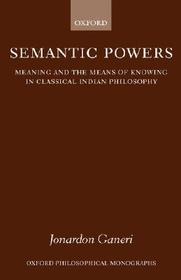
Semantic Powers
Meaning and the Means of Knowing in Classical Indian Philosophy
Series: Oxford Philosophical Monographs;
- Publisher's listprice GBP 150.00
-
67 725 Ft (64 500 Ft + 5% VAT)
The price is estimated because at the time of ordering we do not know what conversion rates will apply to HUF / product currency when the book arrives. In case HUF is weaker, the price increases slightly, in case HUF is stronger, the price goes lower slightly.
- Discount 10% (cc. 6 773 Ft off)
- Discounted price 60 953 Ft (58 050 Ft + 5% VAT)
Subcribe now and take benefit of a favourable price.
Subscribe
67 725 Ft

Availability
printed on demand
Why don't you give exact delivery time?
Delivery time is estimated on our previous experiences. We give estimations only, because we order from outside Hungary, and the delivery time mainly depends on how quickly the publisher supplies the book. Faster or slower deliveries both happen, but we do our best to supply as quickly as possible.
Product details:
- Publisher OUP Oxford
- Date of Publication 25 March 1999
- ISBN 9780198237884
- Binding Hardback
- No. of pages280 pages
- Size 225x144x20 mm
- Weight 452 g
- Language English 0
Categories
Short description:
Jonardon Ganeri gives an account of language as essentially a means for the reception of knowledge. The semantic power of a word, its ability to stand for a thing, derives from the capacity of understanders to acquire knowledge simply by understanding what is said. Ganeri finds this account in the work of certain Indian philosophers of language, and shows how their analysis can inform and be informed by contemporary philosophical theory.
MoreLong description:
Jonardon Ganeri defends a conception of language as essentially a means for the reception of knowledge through testimony. He argues that the possibility of testimony constrains the form of a theory of meaning. In particular, the semantic power of a word, its ability to stand for or take the place of a thing, derives from the epistemic powers of understanders, their capacity to acquire knowledge simply by understanding what is said.
Ganeri finds this account in the work of certain Indian philosophers of language, those belonging to the late classical school of Navya-Ny(ya. He presents a detailed analysis of their theories, paying particular attention to the influential seventeenth-century philosopher Gad(dhara. Ganeri examines the Indian account of the meaning relation and its relata, the role of modes of thought as meaning constituents, and the application of the theory to theoretical names and anaphora.
The aim of Semantic Powers is to give epistemology a central place in the study of language. It also shows how classical Indian theory of language can inform and be informed by contemporary philosophy.
I urge philosphers of language to read this book to become apprised of the classical Indian theorizing at its most sophisticated stage
Table of Contents:
Introduction
The Nature of Language
Instruments of Knowledge
Meaning Relata
The Meaning Relation
Meaning and Modes of Thought
Stipulation
Indexicality
Bibliography
Index

