

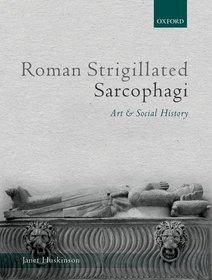
Roman Strigillated Sarcophagi
Art and Social History
-
10% KEDVEZMÉNY?
- A kedvezmény csak az 'Értesítés a kedvenc témákról' hírlevelünk címzettjeinek rendeléseire érvényes.
- Kiadói listaár GBP 145.00
-
65 467 Ft (62 350 Ft + 5% áfa)
Az ár azért becsült, mert a rendelés pillanatában nem lehet pontosan tudni, hogy a beérkezéskor milyen lesz a forint árfolyama az adott termék eredeti devizájához képest. Ha a forint romlana, kissé többet, ha javulna, kissé kevesebbet kell majd fizetnie.
- Kedvezmény(ek) 10% (cc. 6 547 Ft off)
- Kedvezményes ár 58 921 Ft (56 115 Ft + 5% áfa)
Iratkozzon fel most és részesüljön kedvezőbb árainkból!
Feliratkozom
65 467 Ft

Beszerezhetőség
Megrendelésre a kiadó utánnyomja a könyvet. Rendelhető, de a szokásosnál kicsit lassabban érkezik meg.
Why don't you give exact delivery time?
A beszerzés időigényét az eddigi tapasztalatokra alapozva adjuk meg. Azért becsült, mert a terméket külföldről hozzuk be, így a kiadó kiszolgálásának pillanatnyi gyorsaságától is függ. A megadottnál gyorsabb és lassabb szállítás is elképzelhető, de mindent megteszünk, hogy Ön a lehető leghamarabb jusson hozzá a termékhez.
A termék adatai:
- Kiadó OUP Oxford
- Megjelenés dátuma 2015. november 5.
- ISBN 9780199203246
- Kötéstípus Keménykötés
- Terjedelem366 oldal
- Méret 260x210x25 mm
- Súly 1010 g
- Nyelv angol
- Illusztrációk 87 black and white illustrations 0
Kategóriák
Rövid leírás:
This volume is the first full study of Roman strigillated sarcophagi, the largest group of ancient Roman sarcophagi to survive. Manufactured from the mid-second to the early fifth century AD, covering a critical period in Rome, they provide a rich historical source for exploring the social and cultural life of ancient Rome.
TöbbHosszú leírás:
This is the first full study of Roman strigillated sarcophagi, which are the largest group of decorated marble sarcophagi to survive in the city of Rome. Characterized by panels of carved fluting - hence the description 'strigillated', after the curved strigil used by Roman bathers to scrape off oil - and limited figure scenes, they were produced from the mid-second to the early fifth century AD, and thus cover a critical period in Rome, from empire to early Christianity. Roman Strigillated Sarcophagi focuses on their rich potential as an historical source for exploring the social and cultural life of the city in the later empire.
The first part of the volume examines aspects of their manufacture, use, and viewing, emphasizing distinctive features. The second part looks at the figured representations carved on the sarcophagi, and at their social significance and creativity, concentrating on how their various arrangements allowed viewers to develop their own interpretations. The subjects represented by the figures and the flexibility with which they might be read, provide invaluable insights into how Romans thought about life and death during these changing times.
The final part of the volume surveys how later societies responded to Roman strigillated sarcophagi. From as early as the fifth century AD their distinctive decoration and allusions to the Roman past made them especially attractive for reuse in particular contemporary contexts, notably for elite burials and the decoration of prominent buildings. The motif of curved fluting was also adopted and adapted: it decorated neo-classical memorials to Captain Cook, Napoleon's sister-in-law Christine Boyer, and Penelope Boothby, and its use continues into this century, well over one and a half millennia since it first decorated Roman sarcophagi.
In Roman Strigillated Sarcophagi an accomplished scholar provides a grammar for reading (below) the surfaces of Rome's most popular and long-lived sarcophagus type. She also realizes, however, that the inherent ambiguity of images, many evoking a range of meanings now "unknowable", makes translation a fraught enterprise. Still, this comprehensive study clarifies the syntax of a type whose "greatest creative strength" derives from the interplay of its discrete figural fields and the accommodation therein of endless permutations of novel and conventional images.
Tartalomjegyzék:
Preface
List of Figures
List of Tables
Abbreviations
Notes to Reader
Introduction
Introducing Questions
Introducing the Sarcophagi
Part 1: Production, Use, and Viewing
Making and Acquiring Strigillated Sarcophagi
Strigillated Sarcophagi and their Burial Contexts
The Decoration of Strigillated Sarcophagi
Viewing Strigillated Sarcophagi
Part 2: Representations
Representing Romans
Mythological Imagery
Symbolic Figures
Representing Christians and their Beliefs
Strigillated Sarcophagi and the Jewish Community in Rome
Part 3: Reception and Reuse
The Reception of Strigillated Sarcophagi: Introduction
The Reuse of Strigillated Sarcophagi
The Reuse of the Strigillated Design
Conclusion
Glossary
List of References
General Index

