

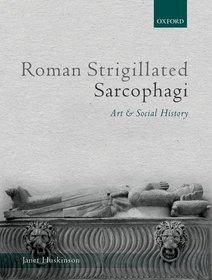
Roman Strigillated Sarcophagi
Art and Social History
- Publisher's listprice GBP 145.00
-
65 467 Ft (62 350 Ft + 5% VAT)
The price is estimated because at the time of ordering we do not know what conversion rates will apply to HUF / product currency when the book arrives. In case HUF is weaker, the price increases slightly, in case HUF is stronger, the price goes lower slightly.
- Discount 10% (cc. 6 547 Ft off)
- Discounted price 58 921 Ft (56 115 Ft + 5% VAT)
Subcribe now and take benefit of a favourable price.
Subscribe
65 467 Ft

Availability
printed on demand
Why don't you give exact delivery time?
Delivery time is estimated on our previous experiences. We give estimations only, because we order from outside Hungary, and the delivery time mainly depends on how quickly the publisher supplies the book. Faster or slower deliveries both happen, but we do our best to supply as quickly as possible.
Product details:
- Publisher OUP Oxford
- Date of Publication 5 November 2015
- ISBN 9780199203246
- Binding Hardback
- No. of pages366 pages
- Size 260x210x25 mm
- Weight 1010 g
- Language English
- Illustrations 87 black and white illustrations 0
Categories
Short description:
This volume is the first full study of Roman strigillated sarcophagi, the largest group of ancient Roman sarcophagi to survive. Manufactured from the mid-second to the early fifth century AD, covering a critical period in Rome, they provide a rich historical source for exploring the social and cultural life of ancient Rome.
MoreLong description:
This is the first full study of Roman strigillated sarcophagi, which are the largest group of decorated marble sarcophagi to survive in the city of Rome. Characterized by panels of carved fluting - hence the description 'strigillated', after the curved strigil used by Roman bathers to scrape off oil - and limited figure scenes, they were produced from the mid-second to the early fifth century AD, and thus cover a critical period in Rome, from empire to early Christianity. Roman Strigillated Sarcophagi focuses on their rich potential as an historical source for exploring the social and cultural life of the city in the later empire.
The first part of the volume examines aspects of their manufacture, use, and viewing, emphasizing distinctive features. The second part looks at the figured representations carved on the sarcophagi, and at their social significance and creativity, concentrating on how their various arrangements allowed viewers to develop their own interpretations. The subjects represented by the figures and the flexibility with which they might be read, provide invaluable insights into how Romans thought about life and death during these changing times.
The final part of the volume surveys how later societies responded to Roman strigillated sarcophagi. From as early as the fifth century AD their distinctive decoration and allusions to the Roman past made them especially attractive for reuse in particular contemporary contexts, notably for elite burials and the decoration of prominent buildings. The motif of curved fluting was also adopted and adapted: it decorated neo-classical memorials to Captain Cook, Napoleon's sister-in-law Christine Boyer, and Penelope Boothby, and its use continues into this century, well over one and a half millennia since it first decorated Roman sarcophagi.
In Roman Strigillated Sarcophagi an accomplished scholar provides a grammar for reading (below) the surfaces of Rome's most popular and long-lived sarcophagus type. She also realizes, however, that the inherent ambiguity of images, many evoking a range of meanings now "unknowable", makes translation a fraught enterprise. Still, this comprehensive study clarifies the syntax of a type whose "greatest creative strength" derives from the interplay of its discrete figural fields and the accommodation therein of endless permutations of novel and conventional images.
Table of Contents:
Preface
List of Figures
List of Tables
Abbreviations
Notes to Reader
Introduction
Introducing Questions
Introducing the Sarcophagi
Part 1: Production, Use, and Viewing
Making and Acquiring Strigillated Sarcophagi
Strigillated Sarcophagi and their Burial Contexts
The Decoration of Strigillated Sarcophagi
Viewing Strigillated Sarcophagi
Part 2: Representations
Representing Romans
Mythological Imagery
Symbolic Figures
Representing Christians and their Beliefs
Strigillated Sarcophagi and the Jewish Community in Rome
Part 3: Reception and Reuse
The Reception of Strigillated Sarcophagi: Introduction
The Reuse of Strigillated Sarcophagi
The Reuse of the Strigillated Design
Conclusion
Glossary
List of References
General Index

