

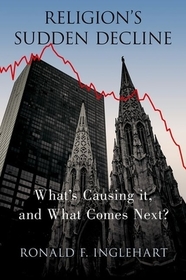
Religion's Sudden Decline
What's Causing it, and What Comes Next?
-
10% KEDVEZMÉNY?
- A kedvezmény csak az 'Értesítés a kedvenc témákról' hírlevelünk címzettjeinek rendeléseire érvényes.
- Kiadói listaár GBP 93.00
-
41 989 Ft (39 990 Ft + 5% áfa)
Az ár azért becsült, mert a rendelés pillanatában nem lehet pontosan tudni, hogy a beérkezéskor milyen lesz a forint árfolyama az adott termék eredeti devizájához képest. Ha a forint romlana, kissé többet, ha javulna, kissé kevesebbet kell majd fizetnie.
- Kedvezmény(ek) 10% (cc. 4 199 Ft off)
- Kedvezményes ár 37 791 Ft (35 991 Ft + 5% áfa)
Iratkozzon fel most és részesüljön kedvezőbb árainkból!
Feliratkozom
41 989 Ft

Beszerezhetőség
Megrendelésre a kiadó utánnyomja a könyvet. Rendelhető, de a szokásosnál kicsit lassabban érkezik meg.
Why don't you give exact delivery time?
A beszerzés időigényét az eddigi tapasztalatokra alapozva adjuk meg. Azért becsült, mert a terméket külföldről hozzuk be, így a kiadó kiszolgálásának pillanatnyi gyorsaságától is függ. A megadottnál gyorsabb és lassabb szállítás is elképzelhető, de mindent megteszünk, hogy Ön a lehető leghamarabb jusson hozzá a termékhez.
A termék adatai:
- Kiadó OUP USA
- Megjelenés dátuma 2021. március 1.
- ISBN 9780197547045
- Kötéstípus Keménykötés
- Terjedelem206 oldal
- Méret 159x241x16 mm
- Súly 426 g
- Nyelv angol 83
Kategóriák
Rövid leírás:
Secularization is accelerating. From 1981 to 2007, the publics of most countries moved toward placing more importance on God; but from 2007 to 2020, the overwhelming majority moved toward placing less importance on God. The United States has long been cited as the key evidence that modernization need not bring secularization, but in the latest survey it showed the largest shift of any country away from religion and now ranks as the world's 12th least religious country.? One generally-overlooked reason is that, for centuries, a set of norms evolved that encourage women to produce as many children as possible and discourages divorce, abortion, homosexuality, contraception, and any other sexual behavior not linked with reproduction. These norms were needed for societies to survive, facing high infant mortality and low life expectancy, but they require people to suppress strong natural urges that no longer are needed for survival, and are rapidly eroding, undermining religiosity.
TöbbHosszú leírás:
Mass attachment to religion is rapidly declining in most of the world; Why, and What comes next?
The world is becoming less religious. Since 2007, there has been a pervasive decline in religious belief and most of the world's people now say that God is less important in their lives than they said He was in the quarter century before 2007. The American public showed the most dramatic shift of all. The United States, which for many years stood as a highly religious outlier among the world's high-income countries, now ranks as the 12th least religious country for which data are available. Many factors contributed to this dramatic worldwide shift, but as Inglehart shows, certain ones stand out. For centuries, virtually all major religions encouraged women to stay home and produce as many children as possible; and they sternly discouraged divorce, abortion, homosexuality, contraception, and any other form of sexual behavior not linked with reproduction. These norms were necessary for societies to survive when facing high infant mortality and low life expectancy: societies that didn't instill them tended to die out. Recent technological advances have greatly increased life expectancy and cut infant mortality to a tiny fraction of its historic levels, making these norms no longer necessary for societal survival. These norms require repressing strong natural urges, but, since they present traditional norms as absolute values, most religions strongly resist change. The resulting tension, together with the fact that rising existential security has made people less dependent on religion, opened the way for an exodus from religion. Utilizing a massive global data base, Inglehart analyzes the conditions under which religiosity collapses, and explores its implications for the future.
"Ingelhart's latest contribution establishes certain facts about religious decline and posits some logical sources for why many citizens in the post-industrial world are losing their religion." -- Paul Froese, Journal of Peace Research
Tartalomjegyzék:
Chapter 1. The Shift from Pro-fertility norms to Individual-choice norms.
Chapter 2. Religion matters.
Chapter 3. The Secularization debate.
Chapter 4. Evolutionary Modernization theory and secularization.
Chapter 5. What's causing it? The rise of Individual-choice norms.
Chapter 6. What's causing it? Insecurity.
Chapter 7. Secularization accelerates in high-income countries.
Chapter 8. What comes next: People need a clear belief system-- What is replacing religion?
Chapter 9. What comes next: At what point does even Sweden get a xenophobic authoritarian party?
Chapter 10. What Comes Next?

