

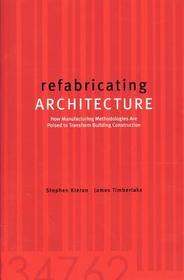
refabricating ARCHITECTURE
How Manufacturing Methodologies are Poised to Transform Building Construction
Sorozatcím: P/L CUSTOM SCORING SURVEY;
-
10% KEDVEZMÉNY?
- A kedvezmény csak az 'Értesítés a kedvenc témákról' hírlevelünk címzettjeinek rendeléseire érvényes.
- Kiadói listaár GBP 26.99
-
12 185 Ft (11 605 Ft + 5% áfa)
Az ár azért becsült, mert a rendelés pillanatában nem lehet pontosan tudni, hogy a beérkezéskor milyen lesz a forint árfolyama az adott termék eredeti devizájához képest. Ha a forint romlana, kissé többet, ha javulna, kissé kevesebbet kell majd fizetnie.
- Kedvezmény(ek) 10% (cc. 1 219 Ft off)
- Kedvezményes ár 10 967 Ft (10 445 Ft + 5% áfa)
Iratkozzon fel most és részesüljön kedvezőbb árainkból!
Feliratkozom
12 185 Ft

Beszerezhetőség
Megrendelésre a kiadó utánnyomja a könyvet. Rendelhető, de a szokásosnál kicsit lassabban érkezik meg.
Why don't you give exact delivery time?
A beszerzés időigényét az eddigi tapasztalatokra alapozva adjuk meg. Azért becsült, mert a terméket külföldről hozzuk be, így a kiadó kiszolgálásának pillanatnyi gyorsaságától is függ. A megadottnál gyorsabb és lassabb szállítás is elképzelhető, de mindent megteszünk, hogy Ön a lehető leghamarabb jusson hozzá a termékhez.
A termék adatai:
- Kiadó McGraw Hill
- Megjelenés dátuma 2003. december 16.
- ISBN 9780071433211
- Kötéstípus Puhakötés
- Terjedelem192 oldal
- Méret 226x149x14 mm
- Súly 263 g
- Nyelv angol 0
Kategóriák
Rövid leírás:
An approach that integrates technology, materials, and production methods to improve quality while saving time and money.
TöbbHosszú leírás:
Publisher's Note: Products purchased from Third Party sellers are not guaranteed by the publisher for quality, authenticity, or access to any online entitlements included with the product.
Preoccupation with image and a failure to look at process has led entire generations of architects to overlook transfer technologies and transfer processes. Kieran and Timberlake argue that the time has come to re-evaluate and update the basic design and construction methods that have constrained the building industry throughout its history. They skillfully demonstrate that contemporary architectural construction is a linear process, in both design and construction, where segregation of intelligence and information is the norm. They convince the reader to look at the automobile, shipbuilding, and aerospace industries to learn how to incorporate collective intelligence and nonhierarchical production structures. Those industries have proven to be progressively economic, efficient, and they yield a higher quality product while the production of buildings stagnates in the methods and practices of the nineteenth century. The transfer they envision is the complete integration of design with the craft of assembly supported by the materials scientist, the product engineer, and the process engineer, all using the tools of present information science as the central enabler.
Publisher's Note: Products purchased from Third Party sellers are not guaranteed by the publisher for quality, authenticity, or access to any online entitlements included with the product.
Preoccupation with image and a failure to look at process has led entire generations of architects to overlook transfer technologies and transfer processes. Kieran and Timberlake argue that the time has come to re-evaluate and update the basic design and construction methods that have constrained the building industry throughout its history. They skillfully demonstrate that contemporary architectural construction is a linear process, in both design and construction, where segregation of intelligence and information is the norm. They convince the reader to look at the automobile, shipbuilding, and aerospace industries to learn how to incorporate collective intelligence and nonhierarchical production structures. Those industries have proven to be progressively economic, efficient, and they yield a higher quality product while the production of buildings stagnates in the methods and practices of the nineteenth century. The transfer they envision is the complete integration of design with the craft of assembly supported by the materials scientist, the product engineer, and the process engineer, all using the tools of present information science as the central enabler.The new architecture will not be about style, but rather about substance -- about the very methods and processes that underlie making. Több

