

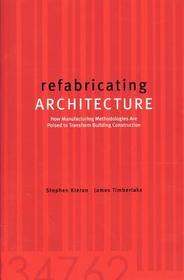
refabricating ARCHITECTURE
How Manufacturing Methodologies are Poised to Transform Building Construction
Series: P/L CUSTOM SCORING SURVEY;
- Publisher's listprice GBP 26.99
-
12 185 Ft (11 605 Ft + 5% VAT)
The price is estimated because at the time of ordering we do not know what conversion rates will apply to HUF / product currency when the book arrives. In case HUF is weaker, the price increases slightly, in case HUF is stronger, the price goes lower slightly.
- Discount 10% (cc. 1 219 Ft off)
- Discounted price 10 967 Ft (10 445 Ft + 5% VAT)
Subcribe now and take benefit of a favourable price.
Subscribe
12 185 Ft

Availability
printed on demand
Why don't you give exact delivery time?
Delivery time is estimated on our previous experiences. We give estimations only, because we order from outside Hungary, and the delivery time mainly depends on how quickly the publisher supplies the book. Faster or slower deliveries both happen, but we do our best to supply as quickly as possible.
Product details:
- Publisher McGraw Hill
- Date of Publication 16 December 2003
- ISBN 9780071433211
- Binding Paperback
- No. of pages192 pages
- Size 226x149x14 mm
- Weight 263 g
- Language English 0
Categories
Short description:
An approach that integrates technology, materials, and production methods to improve quality while saving time and money.
MoreLong description:
Publisher's Note: Products purchased from Third Party sellers are not guaranteed by the publisher for quality, authenticity, or access to any online entitlements included with the product.
Preoccupation with image and a failure to look at process has led entire generations of architects to overlook transfer technologies and transfer processes. Kieran and Timberlake argue that the time has come to re-evaluate and update the basic design and construction methods that have constrained the building industry throughout its history. They skillfully demonstrate that contemporary architectural construction is a linear process, in both design and construction, where segregation of intelligence and information is the norm. They convince the reader to look at the automobile, shipbuilding, and aerospace industries to learn how to incorporate collective intelligence and nonhierarchical production structures. Those industries have proven to be progressively economic, efficient, and they yield a higher quality product while the production of buildings stagnates in the methods and practices of the nineteenth century. The transfer they envision is the complete integration of design with the craft of assembly supported by the materials scientist, the product engineer, and the process engineer, all using the tools of present information science as the central enabler.
Publisher's Note: Products purchased from Third Party sellers are not guaranteed by the publisher for quality, authenticity, or access to any online entitlements included with the product.
Preoccupation with image and a failure to look at process has led entire generations of architects to overlook transfer technologies and transfer processes. Kieran and Timberlake argue that the time has come to re-evaluate and update the basic design and construction methods that have constrained the building industry throughout its history. They skillfully demonstrate that contemporary architectural construction is a linear process, in both design and construction, where segregation of intelligence and information is the norm. They convince the reader to look at the automobile, shipbuilding, and aerospace industries to learn how to incorporate collective intelligence and nonhierarchical production structures. Those industries have proven to be progressively economic, efficient, and they yield a higher quality product while the production of buildings stagnates in the methods and practices of the nineteenth century. The transfer they envision is the complete integration of design with the craft of assembly supported by the materials scientist, the product engineer, and the process engineer, all using the tools of present information science as the central enabler.The new architecture will not be about style, but rather about substance -- about the very methods and processes that underlie making. More

