

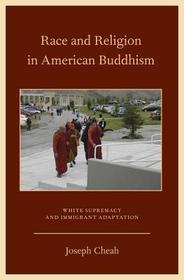
Race and Religion in American Buddhism
White Supremacy and Immigrant Adaptation
Sorozatcím: AAR Academy Series;
-
10% KEDVEZMÉNY?
- A kedvezmény csak az 'Értesítés a kedvenc témákról' hírlevelünk címzettjeinek rendeléseire érvényes.
- Kiadói listaár GBP 102.50
-
46 278 Ft (44 075 Ft + 5% áfa)
Az ár azért becsült, mert a rendelés pillanatában nem lehet pontosan tudni, hogy a beérkezéskor milyen lesz a forint árfolyama az adott termék eredeti devizájához képest. Ha a forint romlana, kissé többet, ha javulna, kissé kevesebbet kell majd fizetnie.
- Kedvezmény(ek) 10% (cc. 4 628 Ft off)
- Kedvezményes ár 41 651 Ft (39 668 Ft + 5% áfa)
Iratkozzon fel most és részesüljön kedvezőbb árainkból!
Feliratkozom
46 278 Ft

Beszerezhetőség
Megrendelésre a kiadó utánnyomja a könyvet. Rendelhető, de a szokásosnál kicsit lassabban érkezik meg.
Why don't you give exact delivery time?
A beszerzés időigényét az eddigi tapasztalatokra alapozva adjuk meg. Azért becsült, mert a terméket külföldről hozzuk be, így a kiadó kiszolgálásának pillanatnyi gyorsaságától is függ. A megadottnál gyorsabb és lassabb szállítás is elképzelhető, de mindent megteszünk, hogy Ön a lehető leghamarabb jusson hozzá a termékhez.
A termék adatai:
- Kiadó OUP USA
- Megjelenés dátuma 2011. november 17.
- ISBN 9780199756285
- Kötéstípus Keménykötés
- Terjedelem192 oldal
- Méret 160x236x22 mm
- Súly 431 g
- Nyelv angol 0
Kategóriák
Rövid leírás:
In Race and Religion in American Buddhism, Joseph Cheah examines how the racial ideology of white supremacy has been played out in the two different ways by which convert Buddhists and sympathizers, and Burmese ethnic Buddhists have adapted Buddhist religious practices to the American context.
TöbbHosszú leírás:
When the first wave of Burmese immigrant Buddhists set foot on American soil in the late 1960s, they came into contact with a variety of forms of Buddhism not found in their native Burma. One of these forms was a white or convert Buddhism, whose legacy includes the specter of an Orientalist and racist past, often hardly acknowledged, yet rarely if ever entirely absent from the discourse within Euro-American Buddhism. The legacy of Orientalism in convert Buddhism can be traced to the works of Western Orientalists in the middle and late Victorian era. Stemming in part from Orientalist racial projects, vestiges of white supremacy ideology can still be detected today in the controversy surrounding who represents "American Buddhism" and the smorgasbord of approaches in Buddhist practices that are taken for granted in many meditation centers, hospitals, and other institutions. The prevailing ideology of white supremacy operative in these and other contexts influences the ways in which Buddhist practices have been adapted by both convert and ethnic Buddhist communities. Within the scope of Buddhism as both a religion and a practice, focusing primarily on the Theravada tradition, Joseph Cheah examines in Race and Religion in American Buddhism rearticulations of Asian Buddhist practices through the lens of race and racialization.
Race and Religion in American Buddhism is an excellent contribution to the fields of religious studies, Asian American Studies, ethnic studies, immigrant religions, and studies of American Buddhism that lays bare the white supremacist assumptions of privilege in the defition of what makes a real Buddhist... Such a book-length study as this stands to transform the discourse on American Buddhism and Asian American religions in significant and much needed ways.
Tartalomjegyzék:
Chapter One: Introduction
Chapter Two: Colonial Legacy of White Supremacy in American Buddhism
Chapter Three: Buddhist Modernism and the American Vipassana Movement
Chapter Four: Adaptation of Vipassana Meditation by Convert Buddhists and Sympathizers
Chapter Five: Assimilationist Paradigm and Burmese Americans
Chapter Six: Monastic and Domestic Settings
Chapter Seven: Burmese Loyalty Structure of the Dual Domination Paradigm
Chapter Eight: Conclusion
Bibliography
Index

