

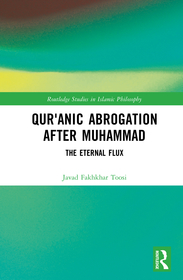
Qur'anic Abrogation After Muhammad
The Eternal Flux
Sorozatcím: Routledge Studies in Islamic Philosophy;
-
20% KEDVEZMÉNY?
- A kedvezmény csak az 'Értesítés a kedvenc témákról' hírlevelünk címzettjeinek rendeléseire érvényes.
- Kiadói listaár GBP 145.00
-
65 467 Ft (62 350 Ft + 5% áfa)
Az ár azért becsült, mert a rendelés pillanatában nem lehet pontosan tudni, hogy a beérkezéskor milyen lesz a forint árfolyama az adott termék eredeti devizájához képest. Ha a forint romlana, kissé többet, ha javulna, kissé kevesebbet kell majd fizetnie.
- Kedvezmény(ek) 20% (cc. 13 093 Ft off)
- Kedvezményes ár 52 374 Ft (49 880 Ft + 5% áfa)
- A kedvezmény érvényes eddig: 2026. június 30.
Iratkozzon fel most és részesüljön kedvezőbb árainkból!
Feliratkozom
58 921 Ft

Beszerezhetőség
Még nem jelent meg, de rendelhető. A megjelenéstől számított néhány héten belül megérkezik.
Why don't you give exact delivery time?
A beszerzés időigényét az eddigi tapasztalatokra alapozva adjuk meg. Azért becsült, mert a terméket külföldről hozzuk be, így a kiadó kiszolgálásának pillanatnyi gyorsaságától is függ. A megadottnál gyorsabb és lassabb szállítás is elképzelhető, de mindent megteszünk, hogy Ön a lehető leghamarabb jusson hozzá a termékhez.
A termék adatai:
- Kiadás sorszáma 1
- Kiadó Routledge
- Megjelenés dátuma 2026. július 31.
- ISBN 9781041050414
- Kötéstípus Keménykötés
- Terjedelem200 oldal
- Méret 234x156 mm
- Nyelv angol 700
Kategóriák
Rövid leírás:
Qur’anic Abrogation After Muhammad: The Eternal Flux presents a bold new interpretive framework for reconciling classical Qur’anic injunctions with the ethical imperatives of the modern world.
Több
Hosszú leírás:
Qur’anic Abrogation After Muhammad: The Eternal Flux presents a bold new interpretive framework for reconciling classical Qur’anic injunctions with the ethical imperatives of the modern world.
Challenging the notion of Islamic legal rigidity, this book introduces the paradigm of “Contemporary Abrogation” - a reformist approach that emerges not in opposition to Islamic tradition, but from within its foundational hermeneutics. Drawing on Sunni and Shiʿi jurisprudential sources, the study reveals how the classical understanding of the Qurʾān’s legal audience was historically limited to the Prophet’s contemporaries, making modern application conditional and situational. By tracing the evolution of this legal reasoning and demonstrating its limitations in the contemporary era, the book argues for the ethical and juridical legitimacy of suspending certain scriptural rulings - particularly in areas such as criminal law, gender norms, and interfaith relations - without abandoning the classical tradition. The result is a powerful case for internal reform grounded in centuries of Islamic linguistic and legal scholarship.
This book will appeal to scholars and students of Islamic studies, Qur’anic interpretation, legal theory, and ethics, as well as to readers engaged in contemporary debates on religious reform, tradition, and modernity in the Muslim world.
TöbbTartalomjegyzék:
Contents
Acknowledgments
Chapter 1. Introduction
Prologue
Pivoting to Abrogation
Legitimacy Through Tradition
Methodology and Objectives
A Roadmap of the Study
The Scholarly Context
Chapter 2. Preliminary Topics
Where the Words Begin
Abrogation in the Dictionary and Terminology
- Abrogation as Removal (Rafʿ)
- Abrogation as Transformation (Tabdīl)
- Abrogation as an explanatory Statement (Bayān)
The Pillars of Abrogation
The Possibility of Abrogation
Abrogation’s Subject
The Philosophy of Abrogation
- Abrogation, Leniency, and Stringency
- Impossibility of Reconciliation as a Prerequisite
Abrogation Conditions
- Revelation, Not Reason
- The chronological succession
- Equal or Greater Authority
- Irreconcilable Incompatibility
- Reliable Tradition
- What Is Not a Condition for Abrogation
The Sources of the Abrogator
- Abrogation by Analogy (Qiyās)
- Abrogation by Consensus (Ijmāʿ)
Types of Abrogatior
- Abrogation of the Qur'an by the Qur'an and the Sunnah by the Sunnah
- Qur'an abrogation by the Sunnah
- Abrogating the Sunnah by the Qur'an
Types of Abrogation
- Abrogation of Both Recitation and Ruling
- Abrogation of the Ruling but not the Recitation and Abrogation of the Recitation but not the Ruling
- Abrogation by Supplementing a Divine Text (Naṣṣ)
- Total and Partial Abrogation
Identifying the Abrogator and Abrogated
Abrogation and Related Concepts
- Abrogation and Specification (takhṣīṣ)
- Abrogation and Al-Badāʾ
Chapter 3. The Doorway to the Contemporary Abrogation of the Qur’an
Where the Words Begin
The Linguistic Theory
- Historical Background
- The Foundations of Theory
- The Nature of Theory
- Implications and Practicality
- The Principle of Universality in Islamic Rulings
The Nexus between the Linguistic Theory and Contemporary Qur'anic Abrogation
- Model 1: Abrogation of the Qur'an through the Lens of Categorical Incoherence
- Model 2: Abrogation through the Defeasibility of the Principle of Universality
Chapter 4. Battle of Theories
Where the Words Begin
The Supremacy of Abrogation over Traditional Modalities of Change
- The Limits of Traditional Tools
- The Modes of Altering Sharia Rulings in Sunni Jurisprudence
- The Modes of Altering Sharia Rulings in Shia Jurisprudence
The Superiority of Abrogation over Modern Theories
- The Contextualist Paradigm
- The Harmonization Paradigm
Beyond the Rivals: On the Superiority of the theory of Contemporary Abrogation over Competing Theories of Naskh
- Maḥmūd Mahmoud Mohammed Taha and his theory of Abrogation by Meccan verses
- Mohsen Kadivar and his Theory of Rational Abrogation
Chapter 5. From Premise to Prooftext: The Application of Contemporary Abrogation to Qur’anic Verses
Introduction to the Chapter
The Verses Resolvable Only Through Contemporary Abrogation
- The Chapter on Jihād (Armed Struggle)
Verse 9:123 (The Verse of Fighting Those Near)
- Chapter on Al-Dayn (Debt)
Verse 2: 282 (The Verse of Debt)
- Chapter on Legal Incapacity (al-Ḥajr)
Verse 16:75 (The Parable of the Slave)
- Chapter on Marriage (al-Nikāḥ)
Verse 4: 3 and Legal Endorsement of Polygyny
Verses 23:5-6 and Sexual Relations with Female Slaves
Verse 4:25 and Marriage with Enslaved Women
Verse 2:221, Interfaith Marriage, and Doctrinal Discrimination
Verse 4:34, Male Supremacy, and Wife-Beating
Verse 2:228 and the Assertion of Male Superiority
- Chapter on Inheritance (Al-Irth)
Verse 4:11: Gender-Based Discrimination in Inheritance Shares
Verse 4:12: Disparity in Inheritance Between Spouses
Verse 4:176: Discrimination in Inheritance Shares between Brother and Sister
- Chapter on Fixed Punishments (Ḥudūd)
Verse 24:2: Flogging as Punishment for Fornication
Verse 24:4 (Flogging for False Accusation)
Verse 5:38 (Amputation as a Penalty for Theft)
Verse 5:33 (Amputation and Crucifixion for Armed Insurrection)
Verse 2:178 (The Injunction on Retribution “Qiṣāṣ”)
The Verses Addressable through Classical Methods and the Theory of Contemporary Abrogation
- Chapter of Al-Ṭahārah
Verse 9:28 : In Tension with Human Dignity, Diversity, and Equality
- Chapter of Jihād
Verse 2:191: The Command to Kill the Disbelievers
Verse 8:65: An Exhortation to Warfare
Verse 9: 73: Command to Fight the Disbelievers and Deal Harshly with Them
Verse 4: 141: Inequality between Muslims and Non-Muslims
Verse 9: 29: Command to Fight the People of the Book and Impose Humiliating Tribute
Verses 47: 4: Command to Execute Prisoners of War
Verse and 8: 67: Command to Execute Prisoners of War
- Chapter al-bayʿ wa-al-tijārah
Verse 2: 47: Prohibition of Usury
- Chapter Al-Nikāḥ
Verse 2: 223: Gender Discrimination through the Portrayal of Female Possession
Verse 24: 31: Mandate of Ḥijāb and Gender-Based Inequality in Dress Autonomy
Chapter 6. Challenges and Implications of Contemporary Abrogation
Introduction
The First Objection: Incompatibility with Classical Principles of Naskh
The Second Objection: The Problem of Ijmāʿ
The Third Objection: The Challenge of Ḥadīth
The Fourth Objection: The Objection from Classical Silence
The Consequences of the Theory of Temporal
Chapter 7. Conclusion
Bibliography
Több
